Lawson is at his best with character sketches. The roles of women, and men's understanding of them. Interaction between the races: how realistic? Recurrent themes, phrases, motifs... clearly not written holistically, with ready access to what had been published previously. Some meta-interest in self, e.g. towards the end, mate making amendments and sending things for publication without asking.
Had a brief stop at this sort-of garden café on the way to dropping Loan off at the (old, now domestic-only) airport. It's on a side-street off the main drag going to the airport, and hence is quite pleasant.
Hitchcock, Cary Grant.
Well, that about wraps it up for this trilogy, at least until they crank out The Hobbit. As a not-particularly-huge fan of the books, I will resist criticising it too much...
The second part of the long-winded Extended Edition. This one didn't drag as much as I remembered it; perhaps they substituted some character development of Frodo for those endless scenes of the rest of them running around New Zealand. Still, it suffers in the same way as every other middle movie, by being not much more than glue. The CGI looks horrendous; not so much the dynamic stuff (the Ents look fine) but the super-fake sets.
Another "official" Trung Nguyên café. Very comfortable, very down-town inner city. Custom-made for the shoppers on the nearby Nguyễn Huệ and Đồng Khởi streets.
A fairly pleasant vertical place on the corner of Trần Hưng Đạo and Nguyễn Văn Cừ on the border of Districts 1 and 5. It feels a bit unfinished; the indoor water feature needs to be repaired. There's no food but you can buy some of the Trung Nguyên trinkets, this being another of the "official" ones.
The super-long three-and-a-bit hour Extended Edition. The pacing and editing of these movies really annoyed me when I first saw them, and that feeling remains undiminished. The CGI looks pretty fake to my eye, but fortunately New Zealand is beautiful enough to overcome all of this.
My first visit to the feted "garden café" with Tigôn. It's expensive (the whole area is expensive, being next to the Diamond Department Store and all), but quite pleasant. Motorbike parking is a bit limited. This one is a bit "official", but I'm not really sure what that means; I thought Trung Nguyên was a franchise.
This is an old article that is probably redundantly reproduced here now that the New York Times has opened their archive. I find it strangely concordant with Bruce Schneier's expert opinion.
In January 2000's column I wrote that 'the defining struggle of the new age would be between Terrorism and Security', and fretted that to live by the security experts' worst-case scenarios might be to surrender too many of out liberties to the invisible shadow warriors of the secret world. Democracy requires visibility, I argued, and in the struggle between security and freedom we must always err on the side of freedom. On Tuesday September 11, however, the worst-case scenario came true.
They broke our city. I'm among the newest of New Yorkers, but even people who have never set foot in Manhattan have felt her wounds deeply, because New York in our time is the beating heart of the visible world, tough-talking, spirit-dazzling, Walt Whitman's 'city of orgies, walks and joys', his 'proud and passionate city - mettlesome, mad extravagent city!' To this bright capital of the visible, the forces of invisibility have dealt a dreadful blow. No need to say how dreadful; we all saw it, are all changed by it, and must now ensure that the wound is not mortal, that the world of what is seen triumphs over what is cloaked, what is perceptible only through the effects of its awful deeds.
In making free societies safe - safer - from terrorism, our civil liberties will inevitably be compromised.1 But in return for freedom's partial erosion, we have a right to expect that our cities, water, planes and children really will be better protected than they have been. The West's response to the September 11 attacks will be judged in large measure by whether people begin to feel safe once again in their homes, their workplaces, their daily lives. This is the confidence we have lost, and must regain.
Next: the question of the counter-attack. Yes, we must send our shadow warriors against theirs, and hope that ours prevail. But this secret war alone cannot bring victory. We will also need a public, political and diplomatic offensive whose aim must be the early resolution of some of the world's thorniest problems: above all the battle between Israel and the Palestinian people for space, dignity recognition and survival. Better judgement will be required on all sides in the future. No more Sudanese aspirin factories to be bombed, please. And now that wise American heads appear to have understood that it would be wrong to bomb the impoverished, opressed Afghan people in retaliation for their tyrannous masters' misdeeds, they might apply that wisdom, retrospectively, to what was done to the impoverished, oppressed people of Iraq. It's time to stop making enemies and start making friends.
To say this is in no way to join in the savaging of America by sections of the left that has been among the most unpleasant consequences of the terrorists' attacks on the United States. 'The problem with Americans is...' - 'What America needs to understand...' There has been a lot of sanctimonious moral relativism around lately, usually prefaced by such phrases as these. A country which has just suffered the most devastating terrorist attack in history, a country in a state of deep mourning and horrible grief, is being told, heartlessly, that it is to blame for its own citizens' deaths. ('Did we deserve this, sir?' a bewildered worker at Ground Zero asked a visiting British journalist recently. I find the grave courtesy of that 'sir' quite astonishing.)
Let's be clear about why this bien-pensant anti-American onslaught is such appalling rubbish. Terrorism is the murder of the innocent; this time, it was mass murder. To excuse such an atrocity by blaming US-government policies is to deny the basic idea of all morality: that individuals are responsible for their actions. Furthermore, terrorism is not the pursuit of legitimate complaints by illegitimate means. The terrorist wraps himself in the world's grievances to cloak his true motives. Whatever the killers were trying to achieve, it seems improbable that building a better world was part of it.
The fundamentalist seeks to bring down a great deal more than buildings. Such people are against, to offer just a brief list, freedom of speech, a multi-party political system, universal adult suffrage, accountable government, Jews, homosexuals, women's rights, pluralism, secularism, short skirts, dancing, beardlessness, evolution theory, sex. These are tyrants, not Muslims. (Islam is tough on suicides, who are doomed to repeat their deaths through all eternity. However, there needs to be a thorough examination, by Muslims everywhere, of why it is that the faith they love breeds so many violent mutant strains. If the West needs to understand its Unabombers and McVeighs, Islam needs to face up to its bin Ladens.)
United Nations Secretary-General Kofi Annan has said that we should now define ourselves not only by what we are for, but by what we are against. I would reverse that proposition, because in the present instance what we are against is a no-brainer. Suicidist assassins ram wide-bodied aircraft into the World Trade Centre and Pentagon and kill thousands of people: um, I'm against that. But what are we for? What will we risk our lives to defend? Can we unanimously concur that all the items in the above list - yes, even the short skirts and dancing - are worth dying for?
The fundamentalist believes that we believe in nothing. In his world-view, he has his absolute certainties, while we are sunk in sybaritic indulgences. To prove him wrong, we must first know that he is wrong. We must agree on what matters: kissing in public places, bacon sandwiches, disagreement, cutting-edge fashion, literature, generosity, water, a more equitable distribution of the world's resources, movies, music, freedom of thought, beauty, love. These will be our weapons. Not by making war, but by the unafraid way we choose to live shall we defeat him.
How to defeat terrorism? Don't be terrorized. Don't let fear rule your life. Even if you are scared.
1. When I wrote these words, I'd meant to say that we'd probably be subjected to more annoying, intrusive checks at airports. I failed to forsee the eagerness with which Messrs Ashcroft, Ridge, etc. would set about creating the apparatus of a more authoritarian state.
Reproduced here (partly to counteract the web's amnesia) without permission from the essay collection Step Across This Line, Copyright Salman Rushdie, 2002.
I am not a JavaScript hacker, so I have no clear idea how best to
use FCKeditor. My embryonic Haskell library just spits out
either a textarea or some JavaScript that creates an
FCKeditor instance depending on how HTTP_USER_AGENT
is set, though I can imagine someone wanting to do something fancier
[*]. The POSTed data is validated against XHTML 1.0
Strict using HaXml, which seems to work well for the most part;
for some reason FCKeditor uses the non-standard
<embed> tag for Flash content, and I can't find
a convincing reason why [**].
In the not-to-distant future I will implement the connector stuff, and Cabalise it.
[*] Apparently I still need to crank out an
<iframe> to satisfy Internet Explorer, so we can
either revert to XHTML 1.0 Transitional or generate some
non-standard XHTML just for Internet Explorer. It's a tough
call.
[**] It seems that recent versions of Internet Explorer (6 and 7),
Mozilla-based browsers (Camino, FireFox) and Safari 3
are all happy with the <object> tag. Adobe has
a "knowledge
base" article full of non-reasons to use the
<embed> tag. The great thing about web standards is
we're all empiricists now...
One reason I ran away from all of the CMS systems implemented in
PHP is its (historically) crappy support for Unicode [*]. Standard
Haskell, on the other hand, has required the Char
type to be able to represent a Unicode codepoint for quite a while
now. Unfortunately there are a few libraries that are not Unicode
friendly, such as just about every library interfacing with C.
Concretely:
- HSQL needed some work to get it to talk UTF-8 to PostgreSQL.
- Most but not all of the CGI library is Unicode friendly. I don't know enough about the various RFCs to know what's encoded as what, so I don't know how to do this right. For example, how are Unicode filenames handled?
- The regexp libs are a bit of a minefield (the user-interface is quite complex, and those C libraries are unknown quantities), so I have avoided using them.
- HOPE itself is almost entirely encoding-agnostic, apart from the top-level (where it builds a CGI header for the webserver's consumption), and HaskellDB just punts around the strings fairly blindly, doing a minimal amount of escaping. Good job, Björn.
I really, really wish Haskell had a decent story about character
encoding at the I/O level. Back in 2002 people seemed to
get really excited about doing something about it, but that
mailing list is dead now. I guess the hope is that once
ByteStrings and all that are bedded down, the I/O layer
can be rebuilt on efficient foundations, fusion will take care of
performance issues with codec layers and so forth.
Update: ConradP has surveyed some Haskell character munging libraries.
[*] perl has good Unicode support, if one is happy to play the guessing game as to what format each string is in. I feel that strong typing — clearly separating characters from strings of bytes — is just what is needed here.
Yeah, this is as good as I remember it, better even.
There are several proofs of this fact, such as this one from 2006. So, why would IBM's DeveloperWorks publish an an article that apparently says otherwise [*]?
Finally, XSLT is the familiar technique that, in a sense, best matches the structure of XML. Perhaps reflecting this match, XSL documents are themselves XML document instances. XSLT is a special-purpose functional programming language that allows you to specify transformations of XML documents into other things (especially, but not only, into other XML documents). Aside from the somewhat annoying verboseness of XSLT, it is limited in its expressiveness — the things you can say are expressed rather clearly (and functionally, not procedurally), but you quickly bump up against all the things that you simply cannot say in XSLT.
OK, so there is an appeal to a Turing tarpit argument, but how about that last phrase, the worrying ... all the things that you simply cannot say in XSLT? Let's keep reading:
The problem comes as soon as you want to filter or compute something for the output — something that is not included in the few comparisons available to XSLT. For example, maybe you want (in a numerological spirit) to display only the even-numbered hexagrams, or only the prime ones. With XSLT, you are out of luck for something this simple.
So, what we have here is something like control completeness — it has enough in the way of control flow constructs — but data-incompleteness — you can't munge your data in all the ways you'd like to. This has always bothered me: how do you prove that you have provided enough operations for your datatype? I'm sure there are people studying algebraic data types and algebraic specification who have some answers for that.
[*] As this article should make clear, the claim of Turing Completeness is weaker and slipperier than most people seem to think.
Halfway through the project, I begin to talk about the project.
Tue, Nov 27, 2007./AYAD/Project | LinkSo the game here is to build a CMS-style website for DRD, who are presently using an unmaintainable ASP mess. (Heh, I think that's the old ASP, not ASP.NET, but what would I know.) I decided to renovate Björn's Haskell effort, HOPE, which looked, superficially at least, pretty hackable.
Activity for these past few months:
- I tried to fix the concurrency issues. There was/is [*] a lot of confusing code that looks like it might be safe, but wasn't. It might have worked if the DBMS provides coarse enough concurrency, and traffic is sufficiently light. (I don't claim to have fixed everything yet, and there are limits to what we can do.)
- As part of the above I hacked the daylights out of HaskellDB
and HSQL, but only conforming their PostgreSQL backends with
my higher-level changes [**]. Specifically I tried to extend their
notions of a relational database to encompass constraints [***], and
add support for the
serialdatatype.- HSQL seems adequate as a low-level SQL interface, at least as far as these things go in Haskell [***], so I don't know why anyone would reinvent that wheel (ask them).
- I would strongly recommend against trying to use HaskellDB, despite the heroic efforts of Björn et al. It's nice in theory but quite limited and very complex in practice. If I were to do this project over, I would drop HOPE's dependency on HaskellDB.
- I am now painfully aware of the semantic gap between Haskell and SQL databases. What we really want is serialisation and querying of algebraic data types, that is, something closer to XML technology. The only group I know that is taking persistence seriously at the typed, higher-order, etc. programming language level is the mob working on Alice/ML, and if I had a spare life I'd marry that with Benjamin C. Pierce's work of the past ten years or so and develop a mergeable, distributed, queryable storage manager for a decent language.
- Added a lot of I18N support. This is as-yet incomplete, of course, and I'm not very happy with how I've done the dynamic part of it. One major outstanding issue is how best to support multi-lingual tagging.
- Shifted away from Björn's home-brew and somewhat buggy
hmarkupto the Windows-user friendly FCKeditor. I have my qualms about this, but I've got to consider my user-base.
Some of the abstractions in HOPE are fantastic, and others are head-scratching, tantalisingly close to being so. If I have the time and enough brain capacity, I'd really like to re-do the notion of resource so we can (for example) generate site maps and have fewer URL paths scattered through the code. So, good effort Björn.
If you're interested in any of this, you can take a look at the darcs repos at http://peteg.org/haskell. Please note that everything there should be considered alpha quality and under chaotic development.
[*] My changes are so pervasive that it's better to think of my version as a fork rather than a continuation. The database schema is quite different and currently requires PostgreSQL, so I doubt it is useful to any current users.
[**] This has some nasty ramifications. One is that it is unlikely that my code will be merged into the mainstream darcs repos, as I have no interest in or time to fix the other backends. (I refuse to encourage anyone to use speed-over-correctness software like MySQL.) Due to this, I doubt one can use the shiny-new cabal-install to suck down the myriad dependencies of my version of HOPE, as you'll need some stuff from my repos, and other stuff may as well come from the official places.
[***] Somewhat ironic to me is that all the low-level Haskell SQL bridges I've seen have a very limited view of what a relational database is; usually the bridge just ships SQL one way and gets a list of rows back, and provides a very basic table description mechanism. I haven't seen any support for defaults, triggers, constraints (foreign keys, primary keys, uniqueness, etc.), and while there is usually support for transactions, it is difficult to figure out what that means as the bridges all try to be backend-agnostic. Conversely there are a lot of attempts at making rows and queries type-safe.
A fancy place just near Mike's apartment building, which is clearly marked on this map (the orange-red thing on the far right). Very comfortable and not too smokey for an indoors joint.
I first saw this strange and wonderful movie about ten years ago with Pete R.. It's a Canadian Naked, albeit not as dense.
Trung Nguyên, 272B Xô Viết Nghệ Tĩnh, District Bình Thạnh.
Sat, Nov 24, 2007./AYAD/HCMC/Cafes | LinkOn the north-western corner of the monster roundabout at the intersection of Điện Biên Phủ and Xô Viết Nghệ Tĩnh (the big fat highway heading north of Hồ Chí Minh City). There's a massive Trung Nguyên sign out the front, but it's otherwise unimpressive.
The ALP has pulled out all the stops to win this election; Sydney gets a spray from Paul Keating, and Melbourne one from RJL Hawke.
A large night-clubby kind of place, with big comfy couches and that special kind of dinginess, quite close to the airport. I went there with Loan after visiting the v-heart project.
Megan McArgle skillfully articulates some keen observations about the economic situation in Cambodia and Vietnam, and in particular how difficult it is to bridge the chasm of cultural norms.
v-heart, a workshop for people with Down Syndrome or Cerebral Palsy in Gò Vấp.
Wed, Nov 21, 2007./AYAD/Disability-Projects | Link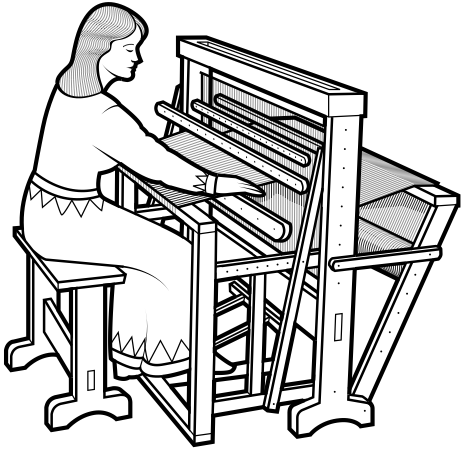
Loan found out about this project from Yumiko-san of the spinal injury project at Cho Ray Hospital. In essence the
participants are trained in the use of a loom that looks to my eye
almost identical to this picture (that I nicked from Apple's
already-excellent and now much-enhanced
Dictionary.app). It's funded by a Japanese group.
That's a first, a Mac OS X update that screwed things up so badly the MacBook ceased to function. Oh well, I now know where an Apple store is in Hồ Chí Minh City; I went to:
Thuan My Co. Ltd - Apple Authorised Reseller
98 Nguyễn Công Trứ, District 1, Hồ Chí Minh City.
Tel: 84 8 8218936, 8218937
Fax: 84 8 8218937
Email: thuanmy-sales@hcm.fpt.vn
and tried to buy a copy, nay a licence, of Leopard. I'll spare you that story. The "update" function failed to work any magic (or didn't like the cafés I went to), but the "archive and install" thing did the trick. I get the impression that some database in my old 10.4 installation got trashed.
Here are some fix-ups for Leopard from around the net (sorry for the lack of attribution). Let's fix the Dock (make it look more like Tiger's):
defaults write com.apple.dock no-glass -boolean YES
killall Dock
and the transparent menubar (cut and paste this line, then — eek! — reboot):
sudo defaults write /System/Library/LaunchDaemons/com.apple.WindowServer 'EnvironmentVariables' -dict 'CI_NO_BACKGROUND_IMAGE' 0.63
Time machine claims to have done something but I haven't tried to use it yet. Spaces is clunkier than I'd expect; using an app that sprays windows around like Finder and expecting some kind of mid-90s "raise" functionality is apparently asking too much. The wifi widget on the menubar finally works like what every user of open networks wants it to. Worth the money? Probably not, but heh, anything to get the MacBook back on its feet. That's the last time I travel without a Mac OS X DVD.
Who'd've thunk it? I just hope it's not another I'm Your Man, where "luminaries" share their uninsightful "insights". Their music speaks for itself.
I voted in the Australian Federal Election at the Consulate just now. According to the lonely Kevin07 guy out the front, that 45 people lined up on Monday morning to vote signals a change of government.
And here was I hoping to see how his Senate campaign unfolded...
What started as a promising politico-scifi Doctor Who-for-adults headed for the crapper somewhere around the beginning of Season 2. Actually, if I could be arsed I'm sure I could pin-point the exact moment when it ceased to be interesting. The final iconic episode is shamed by some of the most unbelievable tosh in the entire genre. What a wasted opportunity.
An incredibly cute three-story house that would be right at home in the Blue Mountains in Australia. A cà phê sữa đá #5 costs just 13 kilođồng, fully 7 kilođồng less than in Hồ Chí Minh City.
Trung Nguyên, 114 Lý Tự Trọng (corner of Thủ Khoa Huân), D1.
Wed, Nov 07, 2007./AYAD/HCMC/Cafes | LinkJust up the road from Bến Thành Market, cunningly concealed on a corner facing away from the traffic streaming down both one-way streets. This one's a cosy little "brown café" that wouldn't be out of place in Amsterdam.
What a strange little movie. Slavoj Žižek's stream of consciousness is not even internally consistent, let alone coherent. It's the decrepit vehicle of psychoanalysis smashing into the 21st century, with all the fascination of a staged car crash.
Revealingly, his wikipedia page says:
One of the problems in outlining Žižek's work and ideas is that for the layperson he seems to change his theoretical position (for instance, on the question of whether Lacan is a structuralist or poststructuralist) between books and sometimes even within the pages of one book. Because of this, some of his critics have accused him of inconsistency and lacking intellectual rigor. However, Ian Parker claims that there is no "Žižekian" system of philosophy because Žižek, with all his inconsistencies, is trying to make us think much harder about what we are willing to believe and accept from a single writer.
I reckon he's fallen off the narrow ridge of helping people to think critically and fallen into the chasm of intellectual stupor. Then again, his tradition is rife with the same, and the public demands its cranks.
I am perplexed that this is rated at 48 in IMDB's top 250. The acting, cinematography, sets, etc. etc. are fine, but the plot is threadbare. This is no Casablanca. Orson Welles.
The twin of the paradigmatic one on Trần Hưng Đạo in District 1. It's a bit more austere and hence less atmospheric, but the coffee is just as good.
I bought this collection in the shadow of the doubts created by the short stories in the Sunday edition of Việt Nam News. Apparently:
Golden Autumn, a selection of short stories from our monthly Outlook magazine, talks about contemporary Viet Nam through authors who offer a variety of intelligent and colourful perspectives on our ever-changing country. Here, ordinary lives, struggles and successes are examined within the backdrop of the nation's emergence from war.
I found most stories to be stultifyingly conventional, and irritatingly politically correct: the women are rarely more than objects to be wronged or righted, and the men are continually evading the forces of the South. One could read this and believe that not much has changed since 1975.
A classic, but somewhat dated now. The chapter on X11 was quite amusing when I was actually using X11, but now it just makes me glad I've slipped that particular noose, and most of the other ones. I wonder how they feel now that their shiny Macs are powered by UNIX.
What a crock. Still more proof that the Booker Prize (awarded to this book in 1986) is worthless; out of the books I've read, I think they got it right, just twice, with Salman Rushdie's Midnight's Children. According to the back of the book, the Guardian said:
Crackling with marvellous taff comedy ... this is probably Mr Amis's best book since Lucky Jim.
Setting the bar this low is hardly an endorsement of anything else he's written. Unlike Martin Amis he didn't seem to have the courage to just run with it.
The full version, with the there's-not-gonna-be-a-T3 ending.
Trung Nguyên, corner of Nguyễn Đình Chiểu and Nguyễn Thiện Thuật, D3.
Sat, Oct 20, 2007./AYAD/HCMC/Cafes | LinkThis one's a bit like the old Century Tavern / Bar Century in Sydney; the downstairs is nondescript, but upon winding up some stairs one finds a hermetic air-conditioned room containing several smokers, with a curved series of windows fronting the street corner. The view here is of a steel telegraph pole, from which a thousand wires emanate. The decor is somewhat similar to both the Century and the standard-setting Trần Hưng Đạo joint.
The upstairs looks like it's setup for karaoke... mirrorballs, lights, those spinning light things.
Addendum to last post: I should emphasise that Trung Nguyên coffee is similar in style to what is found on the streets of Việt Nam, albeit brewed-on-your-table in one of those cute filters they use. Some street vendors only get hot water in the mornings, and so by the time I visit them they only have half-day-old black sludge in a Coke bottle.
Yep, fast times in Hồ Chí Minh City. After the right driver of my (model number lost to history) Sony earbuds died, with more urgency I went looking this afternoon for a pair of headphones that would do some kind of justice to the Dirty Three's Indian Love Song (there's some great dynamics at the start and towards the end) and fit into my pocket. Now, in Hồ Chí Minh City electronics comes in two kinds: authentic expensive stuff and cheap knock-offs. The range at the bottom is huge and uniformly crap, and if one wants something decent one has to fork out and moreover search damn hard.
So, after visiting twenty or more shops selling rubbish, including an abortive and attitude-souring trip out to the "electronics market" in District 10, I headed back to ezone on Tôn Thất Tùng in D1, an apparently unofficial Apple store. They sold me these Shures for $US90, a remarkably modest $US25 markup on Amazon's price. They didn't take Visa, so I had to find an ATM and hand them a brick of cash.
If anyone believes that a fully free market is the solution to the world's ills, then I suggest they come here and try to buy something at a reasonable price in a reasonable time frame. Given the weak state of IP, consumer protection and related laws, the usual signals (brand names, trademarks, price, shop location, etc.) are highly unreliable.
As for the headphones themselves, well, they fit so snugly into my ears that they will surely cause me to have an accident while walking the streets of this town. Conversely eating, drinking or even talking with them on is mildly unpleasant, as one's skull becomes (even more of) an echo chamber.
Oh yes, the most pointless Dirty Three song ever: someone, somewhere, recorded them covering Leonard Cohen's Suzanne for a radio show. I have the evidence in the form of a WAV.
At Galaxy Cinema on Nguyễn Du with Loan. Not bad, but the climax is a bit of a let down. Al Pacino is a bit too old for this kind of schtick.
Perhaps better titled John Pilger's War on Democracy, in the tradition of The Chaser. While I wholeheartedly agree that the issues he highlights are worthy, I struggle with how weak his evidential requirements are. I don't doubt that one could make an almost-identical movie about John Howard's Australia, full of "national security is all" crackpots, and people whose aspirations are stymied. (Just ask any arty type.) His allusions to "secret documents" no longer cut it, if they ever did; put them on the internet, etc. etc.
Vaguely ironic to me is that Vietnam is undergoing massive poverty reduction (etc.) without political instability or a Western-style democracy.
Most interesting is the cult of personality that Chavez has cultivated. Little is made of his recent move to suspend the parliament, while much is made of the coup's move to do the same.
I don't think John Pilger is dishonest; I think the case is strong enough that he could focus on root causes and what's-to-be-done rather than drilling us about the American Empire. (Obviously it exists, and has done so since at least World War II; just look at the major international institutions, especially the economic ones.) It's too much like a Michael Moore movie without the humour.
Dare I say this is Verhoeven's best since Total Recall... The plot is a little clunky at some points, but overall it's very well constructed.
Loan's usual, due to it being a garden cafe and relatively close to DRD. It's part of a chain (I think of three) that includes the one our In-Country Manager Chị Lan took us to, in District 3, back in July. I've got to track that one down...
Earlier in the week I stumped up 450kvnđ for a cheap seat at the Bright Concert, and this evening I waded through about half a metre of water on Lê Lợi to get to the Hồ Chí Minh City Opera House. The Darius Quartet were excellent, but I couldn't get into the arias.
Hồ Chí Minh City is a place to buy coffee, with vendors on every street and every alley (presently exchanging a foreigner's five kilođong for the caffiene-and-sugar hit of a cà phê sữa đá) and all the hotels (the Legend Hotel charges $US3.50 for a very mediocre American-style drip coffee). Mai got me onto the Trung Nguyên cafés, which are apparently a Starbucks-style franchise. If there's anything to be said in favour of tariffs, Trung Nguyên says it; I have difficulty drinking street coffee now.
The problem with it being a franchise (and this being Hồ Chí Minh City) is the difficulty of getting a list of addresses for the cafés. Fortunately I can crib from here (and please excuse the erratic character decorations):
-
1 Trần Hưng Đạo, District 1.
Diagonally opposite Bến Thành Market on the roundabout. The first one I went to, with Loan one Saturday afternoon. My local, I have a table there. Don't be put off by the big love-heart on the door, the waitresses will take good care of you. Head upstairs for more of that 50s Art Deco feeling.
-
On the monster roundabout at the intersection of Nguyễn Bỉnh Khiêm and Điện Biên Phủ at the top of District 1, opposite Mike's workplace, the impressive-looking Institute of Agricultural Science of South Vietnam.
-
On Nguyễn Bỉnh Khiêm between Nguyễn Đình Chiẻu and Nguyễn Thị Minh Khai, District 1.
-
1 Bủi Thị Xuân, District 1, opposite the park.
Somewhat like my local on Trần Hưng Đạo but not as atmospheric. Mai steered me to this one.
-
Nguyen Van Chiem, next to the Diamond Plaza.
Today it was closed for renovations which will clearly take some time.
-
32 Mac Dinh Chi, District 1.
Couldn't find this one, but the numbers go strangely on that street.
I haven't been to (and they may not exist):
- 114 Ly Tu Trong, District 1.
- 44B Chu Manh Trinh, District 1.
- 349 Hai Ba Trung, District 3.
- 150D Ly Chinh Thang, District 3.
- 10 Nguyen Thong, District 3.
- 46 Chu Mạnh Trinh, District 1
- 2A Nguyễn Huệ, District 1.
Apparently one can purchase their coffee in Australia.
Hard to get excited about this movie on a fourth or fifth viewing. If anything, Arnie has too many lines, and the special effects are ambitiously embarassing. The schmaltz is laid on way to thick, and Arnie has little opportunity to ham it up.
err... yes, I am watching too many movies again. I've still got to get to David Lynch's new one, and I saw Al Pacino's face on a billboard here, so I will probably venture back to the cinema some time soon.
I enjoyed this about as much as the first time, but followed the pow-wow much more closely with the help of the pause and rewind buttons.
What a turkey. I last saw this at the cinema when it was released in 2003.
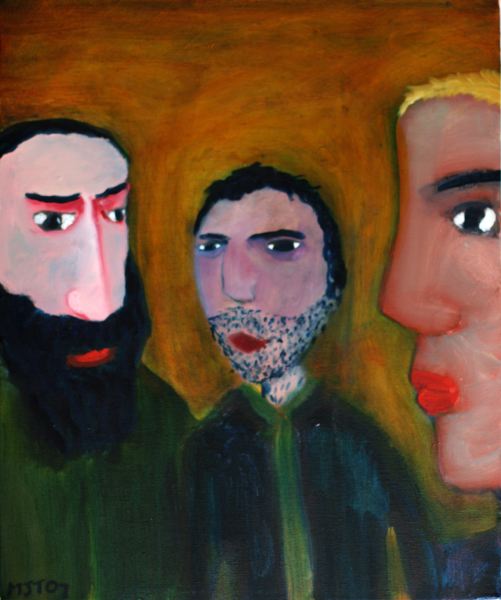
The guitarist for the Dirty Three, Mick Turner, is exhibiting his paintings in Melbourne presently. I especially liked this one, titled Fifteen Year Argument.
Việt Nam News is "The National English Language Daily", published by Việt Nam News Agency.
One can obtain the Sunday edition on Saturday. (Sunday's is more of a Good Weekend-style supplement, a week-in-review and some feature stories, rather than new-news.)
The comic strips are Garfield, Calvin and Hobbes and Rubes. There is a find-these-words-in-a-matrix and a rather strange and Americentric crossword.
There are some editorials but no letters-to-the-editor.
From Tuesday 2007-09-18:
-
City drivers fail to heed traffic safety month: The traffic in the two main cities (Hà Nội and Hồ Chí Minh City) is terrible. Apparently in August there were 987 fatalities and 746 other injuries in more than 1,000 road accidents, though it is unclear if that is just for the cities or country-wide. (I've heard it said that wearing a helmet makes one feel more safe, ergo more likely to push the safety margins, so I wonder if the imminent law making them compulsory will improve these figures.)
There are 3.5 million registered motorbikes in HCMC, which apparently get their riders around at a speed of 3kph at peak times, and 6-8kph at other times; this makes walking look competitive on this basis.
Asian Development Bank projects drop in inflation rate next year: The ADB reckons Việt Nam will have an inflation rate of 7.8 per cent this year, and 6.8 per cent next year. I hope the INGO bean counters are taking note!
Local writers join Swedish book fair: three lucky Vietnamese are having their work featured at the Göteborg International Book Fair. At least one, Hồ Anh Thái's Trong Sương Hồng Hiện Ra (A Rose Appears in the Mist), has been translated into English, apparently under the title Behind the Red Mist.
-
From Saturday 2007-09-22: USAID supports disabled employment:
HÀ NỘI — An employer council was organised yesterday by the United States Agency for International Development (USAID) to discuss strategies for promoting employment of the disabled.
The council, called The Blue Ribbon, aims to provide employment opportunities and skill training for the handicapped and raise awareness of the benefits of hiring them.
"The Blue Ribbon Employer Council is in a position to take the lead and make the business case for hiring people with disabilities in Vietnam," said United States Ambassador to Vietnam Michael Michalak at the first Council meeting.
Assistance programmes worth $US43 million have been launched by the United States to help the disabled in Việt Nam.
This is excellent news, and I hope we hear more about it.
Their main competitor in HCMC is the Saigon Times (apparently a business rag), which I haven't read.
OK, take a deep breath. Look at this page and tell me the world isn't crazy.
Say you want to talk to the world in Unicode, but you want to do
it quickly. Well, obviously you're going to draft C's
atoi and friends to convert numerals to your internal
integer type, right? That's great in theory, but when your code is
running on someone else's webserver that you know little about, things
might get a little tricky.
Haskell's FFI specifies that the functions in the
CString module are subject to the current
locale, which renders them unpredictable on the hitherto
mentioned webserver. I can imagine a numeral encoding that
e.g. strtol_l understands with the locale setting of
today that it fails to understand tomorrow. I don't think there are
enough manpages in all the world to clarify this problem.
Solution? Use integers only for internal purposes, like user
identifiers, render them in ASCII, and use Unicode strings for
everything else. Don't use the CString module, carefully
unpack UTF-8 ByteStrings into Haskell
Strings, and don't expect warp speed. If you're (cough)
putting this stuff in a library, hope like hell your users don't try
anything too weird.
One day someone will resolve all the issues of implementing a proper Unicode I/O layer, and I will thank them for it.
Wow, this isn't anywhere near as bad as I feared. Will Smith is in Men in Black mode, the CGI is over-the-top, and the steady hand of Alex Proyas stops things from getting too out of control. Forget Asimov and don't think too hard. Thanks Rob.
Struck me as a warm-up to his even-racier later movies. He does a better job when the themes are clearer in his mind. Rachel Weisz is luminous, as are the other (lesser-known) actors.
In several sittings, the damn thing is too long to watch in one go. The last time I saw it was in a cinema back in 2002 or so, when the "redux" version was released.
A David Lynch classic, wedged somewhat uncomfortably between his signature Blue Velvet and his later work on Twin Peaks. I reckon this just might be Nicolas Cage's best effort.
Oi, amigo. If ever somethin' don't feel right to you, remember what Pancho said to the Cisco Kid... 'Let's win, before we're dancing at the end of a rope, without music.'
At the Galaxy Cinema with Dũng, Loan and Mai. It was pretty much the same as an Australian cinema, roughly identical to one of the Academy Twin theatres but with worse sound. As the majority of patrons were reading subtitles, the noise levels were pretty high.
Until now I've remained as completely oblivious to the whole Harry Potter phenomenon as anyone can, and I don't think this movie was a good one to start with. Still, a pleasant bit of fluff.
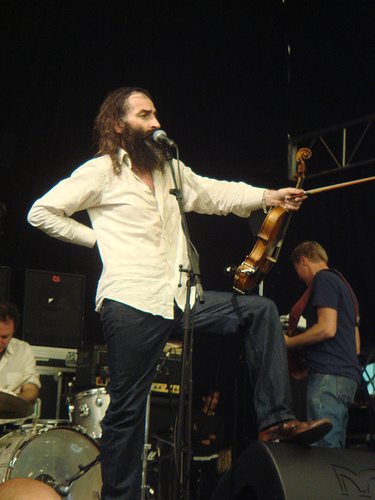
Once more Passion Discs comes to the rescue of we who could not make it to All Tomorrow's Parties. This one is apparently a collection of live tracks; on a cursory listen on the MacBook's speakers, some of them sound familiar. (I've misplaced my headphones and the local knock-off cheapies sound like shit.) The first track is incredibly intense, somewhat like a dense variant of the Dirty Three / Félix Lajkó Zither Player from Cinder. Fortunately it is only two minutes long.
I am glad to see the big man has taken some facial hair cues from Warren Ellis (pictured, shamelessly stolen from Flickr... err, make that an extensive ATP blog entry). I was also very glad to know that I can receive my post in Vietnam, so yeah, bring it on...
Finally someone — in this case Brad Hall — has put up some photos of the Kensington campus as it may once have been. So FaceBook has another purpose afterall, even if it is only as a poor man's Flickr.
- 1990
- 1991 (some photos of the upside-down tree.)
- 1992 (the tree and the old fountain that stood out the front of the Elec. Eng. building.)
- 1993
It strikes me that this might have been really good on the stage, but it doesn't work as a movie. The acting is intermittently excellent, but the climax is too implausible for what we have seen up to that point.
If you make people think they're thinking, they'll love you; But if you really make them think, they'll hate you.
This is just plain terrible. If they want more money, stick on something commercial straight after the news; surely Mary is worth more bums-on-seats as a lead-in than they get from running commercials during her show.
An ancient Kyle MacLachlan vehicle, somewhat worse than one might expect as a follow-up to Blue Velvet but nevertheless reasonably robust for a cop / car chase / soft sci-fi movie. I guess this segues into his Twin Peaks character...
Handicap International: HCMC Spinal Cord Injury Project
Fri, Aug 10, 2007./AYAD/Disability-Projects | LinkIn the afternoon, Loan took me to visit the Spinal Injury rehab centre in District 8, which is quite close to District 1. This place is very impressive, a large peaceful campus on a canal with a lot of facilities for physical and occupational therapy, developed quite recently by some Belgian people.
In the morning Loan took me to visit Trinh's embroidery workshop out in the Phú Nhuận district. The art is quite large, the size of a piece of A4 and larger, and very beautiful. Trinh employs some people with disabilities in the workshop.
If you need to burn serious amounts of time, I suggest you try Desktop Tower Defence, a Flash game apparently similar to Command and Conquer, though I think it's better described as anti-Lemmings.
There's also a Scrabble application on FaceBook that is keeping many people endlessly amused.
This is a distinctly repetitive, and rather depressing, memoir of Robert S. McNamara's time as U.S. Defence Secretary, a period that is not coextensive with U.S. operations in Vietnam. This was the first of many irritations, the lack of framing; we get a very limited presentation of the Eisenhower Administration's policies and almost no mention is made of McNamara's successors or the French colonisation.
The lasting impression I take away from this book is that the U.S. preferred to spend billions on a war rather than thousands on a few more people who would have given it better advice. I grant that it was a chaotic time, but why not hire more people?
Some further links:
- A good review by a professor of political science at Boston College.
- Another review and account of his attendence of a panel discussion of the book at the Kennedy School of Government.
- The book somewhat complements the movie, Fog of War.
Huy kindly took me out to Quận Tân Bình (Tân Bình District, a long way from Quận Một) to visit Mr Phúc, who is the vice-director of Sao Mai Computer Centre for the Blind. We chatted at length about their education projects and web accessibility for people who are (almost) completely blind. In brief, modern screen readers are quite good; the one Mr Phúc uses (JAWS) apparently uses the Internet Explorer engine to figure out what's going on, implying that anything Internet Explorer can render, JAWS can make sense of, including Flash. So apart from the usual web hygiene of standards compliance and good design, I got the impression that there is not much a website need do to be accessible to people who use such assistive technology.
He also had a braille reader, which he told me is lower-bandwidth but higher fidelity, and so is mostly useful for syntactically fiddly things like coding.
I don't know why people hate PayPal; perhaps they were evil in the past. (Actually, reading that website makes me wish Visa et al. got properly into this game.) Anyway, as Vietnam doesn't seem to use phone cards, I wanted to put some cash into Skype so I could call my parents. The payment options are specific to the country where they guess your IP is, and in Vietnam one cannot use PayPal to pay Skype, though PayPal is happy for you to manipulate it from within Vietnam. The only option usable to me — Moneybookers — asks for a mobile phone number in Australia, which may or may not actually need to be valid.
What to do? Well, fortunately the Skype website is accessible, and the server hosting peteg.org is in Australia, so I just used links to punt some cash over. This setup is so stupid — how many ex-pats want to do the same thing? — though I can understand that Skype figures it's better to be safe than useful.
(Thanks André, thanks Adelaide.)
Thea somehow laid her hands on some of Philip Brophy's work, which she played for us at Lush. This included (some of) Evaporated Music (where he overdubbed various filmclips from my childhood), a Hal Hartley-esque homage to Melbourne and a beautiful Japanese girl, and an extended take on the gender wars, framed by an apocalypse.
This whole Unicode fiasco has finally killed X11 as a viable option for me. I wouldn't have thought it was so very hard to provide a complete set of easily-usable Unicode fonts, but there it is.
So, on André's advice, I've switched to:
-
Aquamacs, GNU Emacs with a shiny-happy Mac OS X face. Apart from a lot of minor irritations that come with losing about a decade's worth of XEmacs configuration, it seems quite slick. I tried Carbon XEmacs but it doesn't support Unicode out of the box, and I refuse to spend (more) hours fiddling with it.
-
Terminator, an xterm-alike written in Java, is possibly the best thing ever to run on the JVM.
-
A new bash from MacPorts that speaks Unicode better than the crusty old one that comes with Mac OS X 10.4.x.
Of course I'll still need X11 for sundry old-school things like Isabelle, but there the pain is much less.
So, why Aquamacs rather than a fancy closed-source editor? Well, TextMate crashed on me after about twenty minutes of use — I tried to open a file while saving-as another one, and was madly switching programs trying to navigate the directory tree — and so I recall the cardinal rule of editors: anything less than twenty years old hasn't been tested enough. Whether the (relatively shallow) differences that Aquamacs has to GNU Emacs matter is something I will soon discover.
Cử kindly ran me through a game of Chinese Chess after lunch. As is his wont he played both sides of the board, emphasising strategy and the need to discern the opponent's goals. In his gentlemanly way he engineered a win for me after a bit of back-and-forth.
(This post is also an attempt to get Unicode working. I'm in the market for a Unicode-savvy Mac OS X editor... more later. This entry was brought to you by Apple's TextEdit, which I would almost be satisfied with if it had XEmacs-style M-/ completion, didn't wrap lines, ... oh, OK, it falls fair short. André suggested Aquamacs and TextMate. All I know is that setting up X11 is beyond my patience.)
The first casualty of the tropics came as a surprise to me; apparently the CCDs in Canon PowerShot A75s are prone to humidity and heat issues. This morning I trekked out to the Canon service centre, where the guy took one look at it and told me to come back tomorrow.
The second casualty of the tropics was my throat; I'm having a re-run of (something resembling) that awful green-muck-inducing respiratory disease I had in Canberra. The doctor prescribed some antibiotics, and with all those health warnings we got, I think I'll be taking them this time. Now, to sort out the insurance paperwork...
I have no clear idea what this place is called; the above is from the Lonely Planet. Apparently there is a tradition in many towns in Vietnam for visually-impaired people to be employed as masseurs, though the profession has a somewhat sullied reputation here more generally. This particular establishment is run by the local Association for the Blind.
I went there with Mike after lunch, before playing badminton, which may have been less than ideal. Like many other people I had a less than satisfying experience; it appears to depend a lot on who you get.
Loan, with her cousin, took me to the Sakura Hoa Anh Dao café, where each of the waiting staff are mentally impaired in some way. Cutely they put a stuffed animal on each table to ease the burden of remembering where things need to go to.
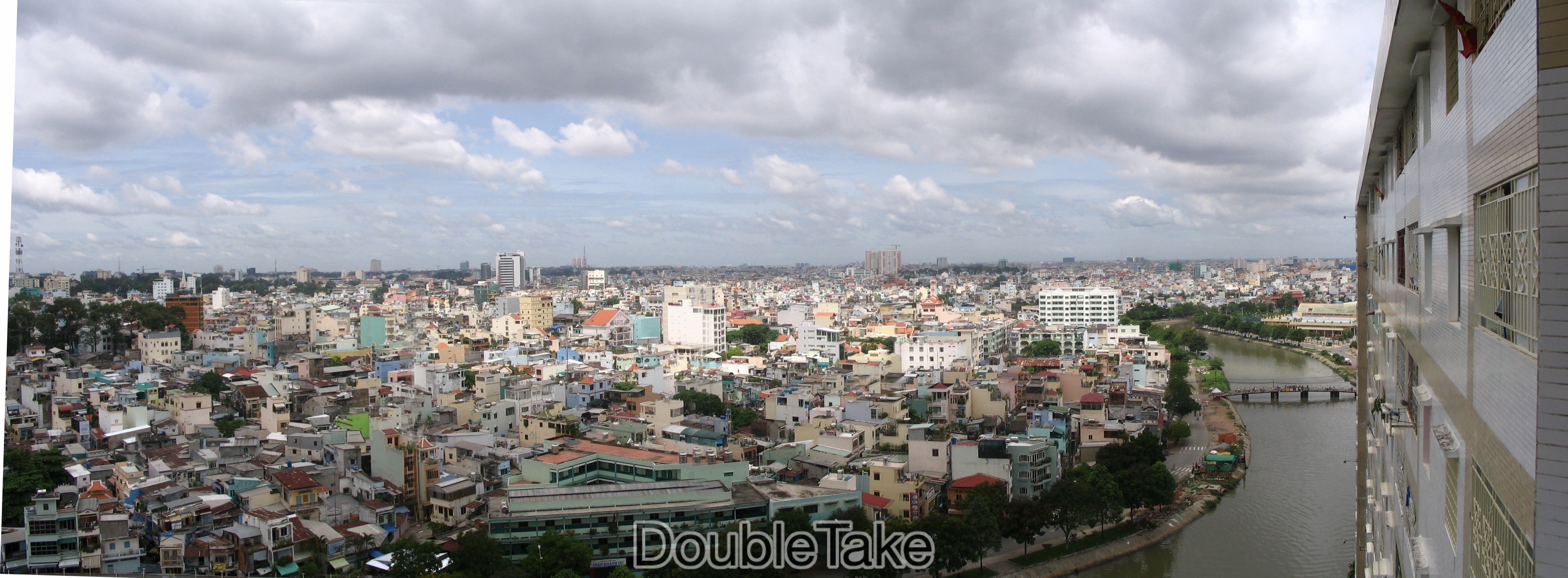
Mike shot this panorama of District 1, looking south from his apartment building, which I think is called the "Mieu Noi Apartments". There are some great photos of the area here, and some stomach-churning images of the canal.
I stitched this together quickly and roughly with DoubleTake, hence the big "DoubleTake". Perhaps I'll redo it with something free, one of these days...
Even after a heavy 4-1 loss to Japan in their final Asia Cup pool match, the streets of Hồ Chí Minh City were abuzz with merry people waving the national flag and honking their horns like they were preparing to overtake the world. Tomorrow will be a national hangover, and I'm sure there'll be a RJL Hawke figure somewhere saying "Any boss who sacks anyone for not turning up today is a bum".
This thing is magic: one can readily write a little script to (in my case) copy images from iPhoto into a Blosxom-friendly location, and output the requisite tags.
I'm still too busy-lazy to do a decent write-up of what's been happening this last week-and-a-bit, so here are just a few pointers for the curious (and my future reference):
-
Google Maps doesn't have a decent map of this city; apparently this is as detailed as it gets. Vinacarta is much better but their geocoding is not that great and the map is not insanely detailed, neither of which come as a surprise to anyone who has tried to find a decent map of HCMC. Here's an attempt at embedding:
I'm staying in a hotel on a lane around about the "o" in Pham Ngu Lao, near the top-left, and the DRD (Disability Resource and Development) office is somewhere on Ho Hao Hon street, which is in the centre at the bottom. I would've marked these in Vinacarta but it doesn't seem to work with FireFox.
Pham Ngu Lao is the backpacker district, so things are a little pricey around here and the touting gets old fast. Conversely it is quite convenient to the downtown, and as the room itself is quite decent I'm content to sit tight for a while yet.
-

The taps in my hotel room are Swedish-style.
-

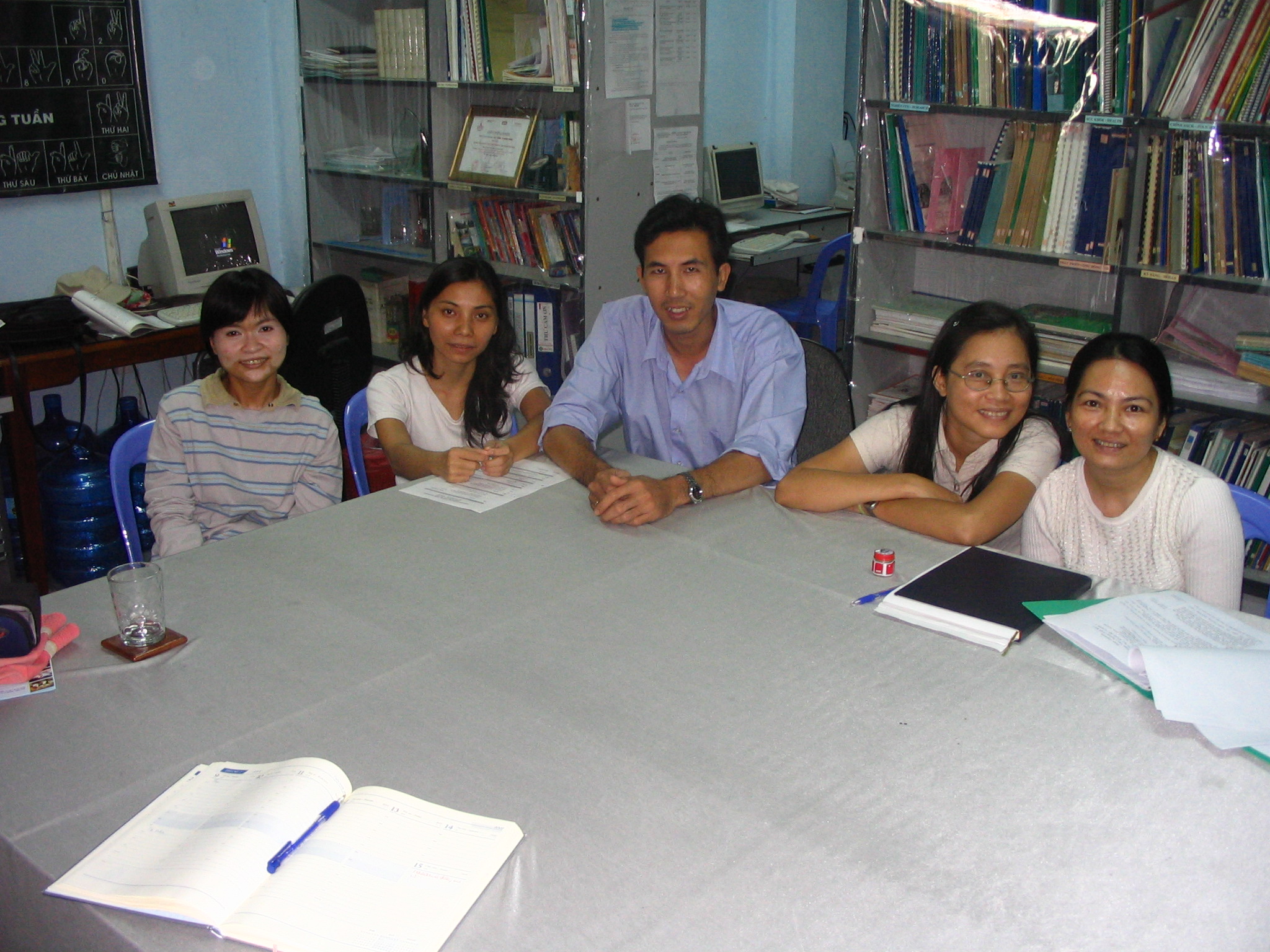
These are my fellow DRD workers, whom I met on Monday. From left to right: Huy (my counterpart for web development), Loan (fingers in may pies), Cử (employment-related stuff, funny man), and two shy ladies who I need to get to know better.
-
I still have no idea how to enter Vietnamese characters into XEmacs or HTML documents, even after some serious googling; the MacBook is of course happy provided I stay in Mac land. The future is doubtlessly Unicode, but the present looks like a mess. So, sorry for the lack of decorations, things will improve in time.
-
There are loads of Vietnamese-English dictionaries around, e.g. vdict. If I have time I want to convert one of these dict-friendly ones to the Apple
Dictionary.appformat.

I start work proper tomorrow, with hours 8am to 11:30am, 2pm to 5pm (I think). The massive thunderstorm tonight will hopefully make it easy to catch up on some sleep.
Is the tap water in Hồ Chí Minh City drinkable? All the tourist sites claim it is not, but the doctor at our training week in Canberra claimed that, with some filtering that would not be considered paranoid in Australia, the water in South-East Asian cities is drinkable. Does anyone know?
The most encouraging comment I can find is here:
Hồ Chí Minh City is one of the places that you CAN drink the tap water - thanks to the US Government, during the American War, and recent massive upgrades using Japanese technology and plastic water mains pipes.
I'd be prepared to give it a go if I can lay my hands on an active-charcoal filter (or better); the photo he showed of a mountain of used plastic water bottles was pretty disheartening.
Update: I spoke with Pat, another AYAD working on urban water quality issues somewhere around here. He claims that the tap water still contains gastro-inducing bacteria.
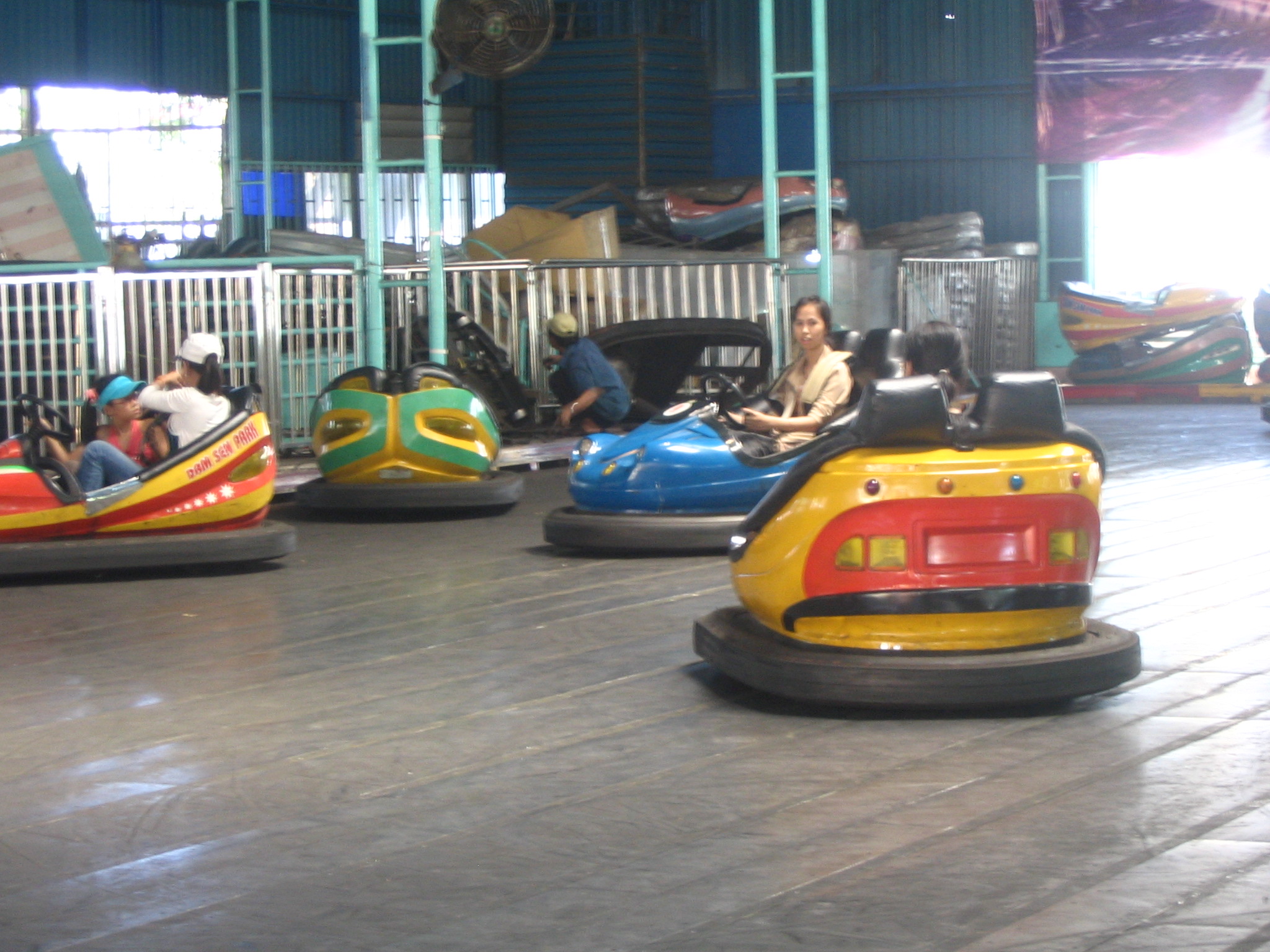
Today I got to see the JICA project that aims to rehabilitate people who have suffered some loss of brain function. They (the medical staff, mostly physical therapists, and Loan and Bich from DRD) took a group of young adults to Dầm Sen Park, in much the same way as I used to help Barb do with the Up! Club. Note the mechanic doing on-the-spot repairs just off the edge of the dodgem car arena.
Yes, he's been at it again. For those of you who missed it:
ladiesman217, but was disappointed (You've got)
The Touch didn't make an appearance.Aptly reviewed on Amazon as being "a bit like reading yesterday's newspaper", this book collects Julian Barnes's New Yorker essays from 1991 to 1994. His take on Thatcher's dying days, and the rise of Tony Blair (whose era coincidentally came to an end recently) entertained me, as did some of his coverage of the Chess World Championship match between Englishman Nigel Short and Gary Kasparov. Perhaps the most intriguing story is about Lloyd's, though it suffers from a lack of framing; the repetition could have been expunged in favour of a potted history, I feel.
At Greater Union on George St, as part of the Sydney Film Festival. I came to this movie with an appreciation of Adrienne Shelly's acting for Hal Hartley, especially in Trust opposite Martin Donovan, and was wondering what she would make of the role of auteur.
This movie is a a bit trite, with a fairly stodgy plot somewhat saved by some decent acting and Hal Hartley-ish moments of direction and dialogue. The opening is quite fun though things go to pot as the serious issues supplant the comedic. The ending is quite sudden and brutal; it is not clear how anything really got resolved. Her male characters are flimsy and creepily unlikeable, though perhaps I missed the erotic subtext. A piece of mostly agreeable fluff.
Another Mike Leigh film. Better than All or Nothing.
With mrak. A longer set this time, second on the bill after some fairly atrocious noise-metal.
Another Mike Leigh. This isn't as good as the earlier stuff.
The movie is fairly gripping, but, like the book except worse, it severely curtails the treatment of the interesting and consequential events between their dogged newspaper reportage and the Watergate tapes fiasco that ultimately forced Nixon's resignation.
With Sarah, on their everyone-gets-in-for-fifteen-bucks night. As the blurb says, this is a set of "three one-act plays about Sydney on the best night of the week", focusing on "the quarter life crisis, beer and a lot of sexual tension..." Given that the protagonists are twenty-five year olds, it is not clear the writer has come to terms with his mortality as yet.
The production is almost setless, using just a few pub familiars — a barrel, a mirrorball, a fancier table — to evoke various drinking ambiences (the beer garden of an urban pub, a gay nightclub, an inner-city bar). Thus the play is largely carried by the actors, who do a solid job with some occasionally dodgy material. All the situations are somewhat stereotypical, which is hardly surprising given what people are looking for in an end-of-the-working-week boozing session, and the humour is a tad forced, more cringe-inducing than clever.
There's a review at Sydney Stage.
Another Mike Leigh masterpiece. More measured than its truly excellent predecessor Naked, about the same pace as Vera Drake.
Has this man made a crap movie?
Quarterly Essay #26, David Marr: His Master's Voice: The Corruption of Public Debate under Howard
Sun, Jun 10, 2007./noise/books | LinkTo think of this unfocussed essay as essentially another, better written, chapter of Silencing Dissent would be both apt and to miss the point. As the pull quote on the website says:
More than any law, any failure of the Opposition or individual act of bastardry over the last decade, what's done most to gag democracy in this country is the sense that debating John Howard gets us nowhere.
The Smage review abbreviates the quote and swiftly rebuts it:
The frustration is palpable as David Marr writes, "What's done most to gag democracy in this country is a sense that debating John Howard is futile".
It's not, as the polls are showing on a weekly basis. But for much of the past decade this is how it has felt to those who do not share the Prime Minister's political and social agenda. Marr describes how the terms of engagement in public discussion have evolved — deteriorated — during the long years of the Howard Government.
I almost choked on my Weetbix; since when has an opinion poll been a debate? Perhaps, like electricity and frogs' legs, they indicate that some force is at work, but what? Let not informed debate inform that, lest the Government lose control of the agenda! Elsewhere, at The Australian, the faceless editorialist similarly opines:
This last thesis [that Australia is becoming an increasingly authoritarian state where dissidents are silenced], expounded at length in Silencing Dissent published earlier this year, would seem difficult to sustain at a time when the marketplace of ideas has never been so crowded. In newspaper opinion sections and magazines and on radio and televisions and increasingly online, Australians are engaged in intelligent conversation about the issues of the day great and small. Blogs and internet chat rooms have given everyone a seat at the debating table. Technology has lowered the barriers to publishing. A host of new periodicals online and in print including The Monthly, New Matilda and The Australian's own Australian Literary Review are providing new platforms for discussion while established journals such as Quadrant and the Griffith Review are reaching new readers and providing a home for new writers. The queues outside venues at this year's Sydney Writers Festival, record attendances at similar writers festivals around the country and new events such as next month's Adelaide Festival of Ideas are public expressions of a confident, mature democracy in which informed debate flourishes.
Ah yes, if people are talking, they must be debating! How could they not be contributing to Australia's democratic future if they are sitting around in cafés, lecture halls, cubicle farms talking about John Howard? Clearly there is discourse in the public sphere, and these polemics are not complaining so much about the amount of it, but how it is informed and almost entirely summarily ignored along petty partisan lines. For the Government to be blown around by the winds of focus groups and opinion polls, as apparently advocated by the Smage, is to reveal how small an agenda it has now that most of its narrow ideological goals are in train.
It is the restriction of the foundational acquisition and dissemination of hard information that is troubling; this is an expensive business (look at how much your average university professor is paid and how much knowledge they produce) that the media is loathe to do a decent job of in these times of economic rationalism. If whisteblowers are persecuted, public servants valued only in their capacity as executors of Government policy, Freedom of Information requests evaded, and so forth, are we not well on the way to thinking of citizens purely as voters, entities of limited memory and interest whose coarsely aggregated opinions only matter once every three years or so?
It makes more sense to consider Marr's piece a response to Judith Brett's Quarterly Essay 19: Relaxed and Comfortable: The Liberal Party's Australia, where the intelligentsia is entreated not to abandon the field to Howard, but to join him out in the middle, the mainstream, arguing for the future of this country. Marr finds this futile, as the pull quote makes abundantly clear. The above-quoted editorial from The Australian goes on to insist that the "left" is completely dysfunctional and has dealt itself out of the debate, though the "argument" left me cold; take, for example:
Closely related to their hatred of the US is their contempt for capitalism. The impact of the modern share-owning democracy has yet to dawn on them. Corporations no longer answer to the bourgeoisie, they answer to shareholders -- ordinary people who are now stakeholders, either directly or through the $1 trillion in superannuation. Karl Marx's dream has been fulfilled now that the workers truly do control the means of production.
Any given worker may now own 0.000001% of some very large means of production, but even that much control is diluted by the fund managers and the machinations of the big boys. One only has to look at Rupert Murdoch's poison pill to see what kind of stakeholding The Australian has in mind; "privatise the profits, socialise the losses" springs to mind, albeit from the broader perspective of influence rather than just money.
Andrew Norton's review (and the ensuing commentary) is much more thoughtful than those of the mainstream press, though I mildly disagree with his closing (unargued for) claim that "Public debate [...] is not under any threat". Andrew Bartlett's comment there almost makes me mourn the passing of the Australian Democrats. Also Andrew Elder treads similar (good) ground.
Like clockwork, a first Sunday of the month and another production from New Theatre. This is song-and-dance, and as it was billed as such I got pretty much what I expected, viz something not to my taste. The cast put in a solid effort and the political message — the horrors of war, the perfidious propaganda that sells it — comes across loud and clear.
The original one with Frank Sinatra in it. Directed by John Frankenheimer.
I did not understand this movie.
If you have ever wanted to ship data to or from your X11 environment,
check out pbcopy and pbpaste. Now, if only X had a
sane cut-and-paste
model, we'd be home...
A sort-of-sequel to All the President's Men, recounting the events up to Nixon's resignation. As before, it ends rather abruptly and one has to scour Wikipedia for a few hours to figure out what the longer-term implications of Watergate were. In short, those with fingers in the operational pies seem to have been fed to the tigers, and the political and Cabinet associates (such as Kissinger, Haig and Cheney) either continued or were resuscitated in later Republican administrations.
These are a great pair of books, though you'll need (to acquire) a working knowledge of (some) U.S. constitutional law if you want to follow the legal narrative, which is what it's mostly about, of course. I'm not aware of similar books about the Dismissal; I've read Gough Whitlam's The Truth of the Matter, but that's it.
With Rob at The Ritz.
Couldn't pass up on the last NUTS gig of the session, however much the pitch lacked specifity. This is an absurdist play set in an asylum, and while the production was great I didn't get much of a handle on it.
Ah, at long last, another film from Hal Hartley. I first heard about this, his sequel to Henry Fool back in 2005 or so.
The plot is pretty much spaghetti, and while it demands a lot of suspension of disbelief it is easier to follow than The Girl From Monday. Most of the old characters return, though the old familiar settings of the neighbourhood, the garbage processing facility and the deli are replaced by some fairly generic European ones, as one might expect from Hal Hartley's assertion that making movies in New York is too expensive these days.
Give it a go, it's a lot of fun.
Apparently these Daniel MacIvor efforts date from the mid-to-late 90s. The first, This is a Play, is a short piece where the actors articulate their inner monologues and stage directions for the most part... a meta-activity that I found funnier than I would have expected, perhaps due to the (as usual) excellent acting.
The meat of the evening was definitely the longer Never Swim Alone, where a woman in a blue swimsuit (Lotte St Clair, also in the first play) referees two suited men in a mostly-verbal contest of masculinity. The recycling of cliché and drifting in and out of sync of the two actors' schtick (Tim Major, Michael Howlett) is fantastic, and clearly requires immense concentration from them. It's difficult to say much beyond what's in the blurb without saying too much.
One might view this as the culmination of a thirty-hour David Lynch movie (the Twin Peaks TV series), and as such it is pretty pointless, just making explicit what we already knew or guessed from the show. I think he should've ridden the ambiguity a bit more.
Anyway, from the TV show: "Denise" is David Duchovny's cross-dressing DEA agent character. Apropos schoolgirl Audrey, who has just kissed FBI Special Agent Cooper full on the mouth:
Denise: I may be wearing a dress, but I still pull my panties on one leg at a time, if you know what I mean.
Cooper: Not really.
Hmm, perhaps you just have to watch it for yourself.
Edited by John Barnes. There's not much point to this collection, given that you can get most/all of Lawson's work online, for free, or, if you prefer, his complete prose works in book form. (In my defence it cost me two bucks at the UNSW book fair, one of the more expensive acquisitions of the day.)
Having said that I did quite enjoy the Joe Wilson and his Mates yarns. These serve as a sort-of autobiography of the man, purportedly written while he was in London. His prose is mostly prosaic, with the occasional flinty observation tossed in, just to check you're paying attention.
After doing the eastern side of the ridge, I figured I'd return to the beautiful Berowra Waters for an overnight day-length walk. Unfortunately the map from the Great North Walk info pack led me astray — their estimate of a day for this trek was wildly inflated. Starting at 1:30pm I did the loop in less than four hours, getting home in time to watch Australia steal a win against Wales in the first rugby international of the season. So yeah, it was pleasant taking the tent/sleeping bag/mat/cooking gear/... for a walk, but in this weather one could get by with just a litre or two of water.
I had in mind to head up past Berowra Waters on the Sunday, as the camping options are a bit limited north of that point, but it seemed pointless to pitch a tent at 5pm. The track itself is very well signposted and quite a bit runs along fire trails, allowing a decent pace. There is some up-hill just near Sam's Creek, but nothing too arduous.
This is so strange; somehow in these past few weeks UNSW has garnered a lot of press for what look like pretty shitty reasons:
-
The Arts faculty can't afford teaching support staff (tutors). While I sympathise with this predicament and fully expect the students' experiences to slide even further down the crapper, I'm not sure Senior Associate Dean of Arts and Social Sciences Dr Sarah Maddison is completely right to sheet the blame home to the Feds:
"The Federal Government has abandoned the humanities in higher education funding and we are bearing the brunt. It has consistently underinvested in this area over the past decade and we are now at a structural disadvantage when compared with other disciplines."
My understanding (and I'd like to be corrected if wrong) is that the funding decisions at the Faculty level are handled by the Chancellery, within the uni. Sure, the Feds may well have decided that a NICTA-like entity for the social sciences would be tantamount to offering an arse-cheek to a tiger, but that is about research, not teaching. Let them blame Professor Fred Hilmer, I reckon, then sack the lot of them.
-
In the same Smage article, the uni has announced that it will reduce the academic session to twelve weeks from the current fourteen. Justification?
The staff cuts follow the announcement of a number of streamlining measures at the university, including the reduction of the teaching semester from 14 to 12 weeks and a review of the bachelor of arts degree. Under the review, the number of courses in which students can major will fall from 45 to 37 in 2009.
The university administration claims the changes are designed to "streamline teaching and learning".
In a message sent to students on Monday, the pro-vice chancellor, Professor Joan Cooper, said the reduced semester would bring "UNSW in line with other Australian universities" and "facilitate new pedagogic practices".
Yep, I regret that my education was not streamlined. According to JAS the main operational implication is that all courses need to be adjusted (mangled) into this new format, and apparently the Chancellery is yet to propose how this will be funded. Blame Professor Fred Hilmer I reckon. You'll note the reasoning is similar to his world class policy on general staff numbers. Still, I'm sure the clown will be all cashed up for another year of hijinks. "I came to UNSW for the morale of the student body," I can hear it now.
-
Strangest of all is the closing of the Singapore campus (UNSW Asia) after less than a session:
The university has already spent $17.5 million on the project, but it had guaranteed a further $140 million for the construction of a permanent campus in South Changi.
Professor Fred Hilmer said the university had lost $15 million in not reaching its anticipated enrolment numbers, and as a result it was unable to borrow the money it needed. "I don't want to play a blame game [but] I inherited a situation," he said.
Those enrolment numbers, from an email he sent to staff:
The UNSW Asia campus currently has 148 enrolled students, with some 100 of these being Singapore residents. The anticipated enrolment for the initial intake in 2007 was 300 students. Second semester enrolments were anticipated at 480 students but it is clear that this target would not be met.
Those enrolment numbers, from the advertising agency:
Singapore - The University of New South Wales Asia (UNSW Asia) has awarded its regional creative and media accounts to AGI Communications - the agency won the business without a pitch.
The new tertiary institution made the retainer appointment - understood to be valued at around $1.5 million - on the back of its launch in Singapore, in an effort to achieve its first year admission target of 1200 students through attracting students from across Asia.
Still, I'm glad he can exercise the wagging figure this time, for otherwise one might get the impression there's something rotten in the administration of this world-class institution.
Now, if they were in any way serious about bringing "UNSW in line with other Australian universities" or being even more world-class they'd be looking at the University of Melbourne's "Melbourne Model" and wondering if they couldn't interest the Sydney market in something similar, or perhaps even better.
At The Ritz. An interesting subject (an FBI agent, devout Catholic, etc. selling U.S. secrets to the Russians), a boring portrayal. Reality is too tedious for these Hollywood monkeys, so we get a sexed up thriller that omits such things of general interest as motive (why continue to pass information to the K.B.G. for ten years after the cold war came to an end?) and the nature of the secrets that were passed (OK, don't speculate, just tell us that remains classified). But hey, bright shiny thing, we've all got ADD now.
The last time I looked at Laura Linney and had any other reaction than "oh, that's Laura Linney" was when she played the wife in The Squid and the Whale. I thought she was wonderful in that role. The lead young bloke struck me as a proto-Matt Damon (shudder).
Frankly, I think getting off in public over the fact you married a hot, famous woman is kind of rude. Why couldn't Aronofsky and Weisz celebrate their love by doing what everyone else does and film themselves having sex?
The book which, while preceding the movie, was apparently written because of it. Again, the irritation is that it focuses on the authors' part of the story, and suddenly stops when things get really weird (p331, five pages to go):
On Saturday the 14th, Woodward received a phone call at home from a senior memeber of the [Senate] committee's investigative staff. "Congratulations," he said. "We interviewed Butterfield. He told the whole story."
What whole story?
"Nixon bugged himself."
I would have preferred the narrative to be situated in history a bit better, such as by clueing us into other events in the U.S. by providing some correlative newspaper headlines.
With Sarah. A flash-in-the-pan script, saved by some great actors. The plot ambled along in a somewhat predictable fashion, with the requisite double, triple twist and a half-pike. The NSW State Government has been replaced by a mortgage board and the citizenry is stratified according to their real estate interests in a semi-articulated spaghetti of health insurance and voting rights. Marrickville is now part of Balmain, just "several stone throws" from the harbour. Melbourne has, of course, managed to retain its social democracy and is otherwise the usual cliché of itself.
Sydney has supposedly gone bonkers over this play, and while it is a sharper comedy than Sold, it comes at the cost of being blandly impersonal. The characters, while amusing and well played, are all scumsucking bottom feeders.
Trekked up to Gordon/Pymble, mrak territory, who had the good sense to be in Newtown. The second-hand bookshop there is a real trove of Australiana, and Gordon Thai is not terrible for a non-inner-city Thai, albeit not somewhere one can rock up and expect to get a table without a booking.
What drug me up here was a production of David Williamson's venerable Travelling North, purportedly one of his best. I still haven't seen the movie, featuring Graham Kennedy, much to my chagrin.
This production, being community theatre, was a bit uneven but of high standard. The dialogue was quite amusing, and great use was made of the large fixed set. The play itself has mildly dated, with some cultural referents likely to be missed by people born around that time who aren't politics junkies.
Specifically, Brecht's How Much is Your Iron? and Woody Allen's God: A Play. The Brecht play left me a bit cold, which was perhaps the intention. It smacked of the classically unsettling First they came... poem.
The night definitely belonged to Allen's raucously irreverent play, with the first third being so chaotic that one can barely draw breath between such gags as:
ACTOR: You idiot, you're fictional, she's Jewish - you know what the children will be like?
By the time the chorus issue the instruction:
CHORUS: Let's go, Phidipides, the play is bogging down.
the play has indeed bogged down and become quite difficult to follow, which was probably intentional. Heck, it was all intentional; hassling the audience, that's a bit cheap... until you realise they're all plants, every last one of them.
Again, it's a shame NUTS doesn't run this one for longer to larger audiences.
Clive Hamilton and Sarah Maddison: Silencing Dissent: How the Australian government is controlling public opinion and stifling debate.
Tue, May 01, 2007./noise/books | LinkI finally finished reading this book, so long after the book launch. In many ways I found it unsurprising and somewhat pointless; it catalogues and sometimes adds to the vast piles of evidence that the current government is a mendacious, insecure mob of control freaks. I can't imagine anyone who doesn't already suspect that will read this text, and so I have to wonder what the target audience was imagined to be. The only things I found novel were the instances of modern-day heroism in the public service, and even those couldn't keep me awake. (I mostly read it after midnight.)
One thing that struck me as less than helpful was the stridently bare ideology in this potted take on public choice (p32, Dissent in Australia, Clive Hamilton and Sarah Maddison):
At a deeper level, the revisionist view of democracy advanced by the Howard Government rests upon a particular belief about human nature. This view considers that it is normal and natural for people to be the self-interested 'rational maximisers' known as homo economicus in the economics textbooks. In this view human beings are understood to be 'fundamentally acquisitive creatures' for whom 'consumption and acquisition are the means to happiness'. The purpose of society, then, is 'to provide the secure space in which these naturally self-interested individuals are left free to discover and pursue their own (basically material) happiness'. This is hardly a modern view; the idea of government as being structured around the self-interested individual dates back to Hobbes and Locke. In the modern variation — known as rational choice theory, and its offspring, public choice theory — citizens are regarded as having little concern with democratic participation unless it is in their own material interests. In turn the model of government designed to support the activities of the 'instrumentally rational egoist' is a 'minimal democracy' that can at best provide 'few safeguards against tyranny'.
Offered up to support the quotes are Australian Politics (Emy and Hughes) and Deliberative Democracy and Beyond (Dryzek, what a great name). Me, all I've got is Wikipedia and a smattering of Amartya Sen's work. While I agree that taking any of these theories to be normative might lead one to think their conclusions are profoundly distasteful, the mostly negative mathematical results are enough to convince me that they're still working on the foundations. Rationality here is just the set of extra assumptions needed to make the model tractable, and it clearly is a poor approximation of human behaviour. No surprise that the hot new trend has a strongly psychological flavour.
Still, this paragraph does make a good point (by example) in conflating the limitations of the models with their supposed support for a highly artificial set of desiderata, something I'm sure the political public choice theorists encourage. Take, for example, Jane S. Shaw's overview of this discipline for The Concise Encyclopedia of Economics:
One of the chief underpinnings of public choice theory is the lack of incentives for voters to monitor government effectively. Anthony Downs, in one of the earliest public choice books, An Economic Theory of Democracy, pointed out that the voter is largely ignorant of political issues and that this ignorance is rational. Even though the result of an election may be very important, an individual's vote rarely decides an election. Thus, the direct impact of casting a well-informed vote is almost nil; the voter has virtually no chance to determine the outcome of the election. So spending time following the issues is not personally worthwhile for the voter. Evidence for this claim is found in the fact that public opinion polls consistently find that less than half of all voting-age Americans can name their own congressional representative.
Public choice economists point out that this incentive to be ignorant is rare in the private sector. Someone who buys a car typically wants to be well informed about the car he or she selects. That is because the car buyer's choice is decisive — he or she pays only for the one chosen. If the choice is wise, the buyer will benefit; if it is unwise, the buyer will suffer directly. Voting lacks that kind of direct result. Therefore, most voters are largely ignorant about the positions of the people for whom they vote. Except for a few highly publicized issues, they do not pay a lot of attention to what legislative bodies do, and even when they do pay attention, they have little incentive to gain the background knowledge and analytic skill needed to understand the issues.
Public choice economists also examine the actions of legislators. Although legislators are expected to pursue the "public interest," they make decisions on how to use other people's resources, not their own. Furthermore, these resources must be provided by taxpayers and by those hurt by regulations whether they want to provide them or not. Politicians may intend to spend taxpayer money wisely. Efficient decisions, however, will neither save their own money nor give them any proportion of the wealth they save for citizens. There is no direct reward for fighting powerful interest groups in order to confer benefits on a public that is not even aware of the benefits or of who conferred them. Thus, the incentives for good management in the public interest are weak. In contrast, interest groups are organized by people with very strong gains to be made from governmental action. They provide politicians with campaign funds and campaign workers. In return they receive at least the "ear" of the politician and often gain support for their goals.
I guess you can see where that is going. I find the use of rationality here persausive, even if the portrayal of private enterprise is overly narrow and rose-tinted; my experience of corporate Australia is that the meat is not lean, and most are awestruck by the Enron fiasco. And yet there is an alternative to the right-wing minimalist (or absent) government: a more participatory democracy, a path that the Swiss have taken without apparent catastrophe. As Australia's infrastructure crumbles (specifically universities and urban transport, at least in Sydney), the populace will have no choice but to turn away from the high-def plasma for long enough to make their opinions felt.
None of this is to say the book shouldn't be read, indignation raised, action taken, but when the revolution comes I doubt anyone will say this is what got them off their arse. David Marr wrote an upbeat review for the Smage, though his closing observations are similar to mine:
The trouble is, the nation seems to care little about the successes or the failures in Canberra's long war against information. "While Australia has been transformed," Manne writes, "large parts of the nation have seemed to be asleep."
I have to say, bleakly, that these days this is only rational.
Once again I headed over to New Theatre for their free-for-the-unwaged-and-students showing of their latest production, this time being Life After George. Apparently this play dates from the late 90s, and partakes in a lot of the "we're rooned" yelping that surrounded the universities at that time. (Now I think most are (or have) resigned to just waiting for a change of government.) The playwright, Hannie Rayson, is more recently famous for biting the hand that starves in Two Brothers.
The play itself is stridently Eurocentric, with a backdrop of the modern and post-modern intellectual political fashions from Oxford, to 1968 Paris, to ... Melbourne, pre Dame Edna. The ambit is to flashback through Professor George's life, using the four women central to it to represent each of the eras in which he operated. Melbourne (Uni) is a hothouse of sex and dissent, with Sydney mentioned only as somewhere to dispose of one's children (by adoption, in this case).
As far as production goes, the set is of the minimalist unvarying type symptomatic of independent theatre. As a lot of the play is speechifying, the audience is often looking back over their shoulders wondering who's being talked to.
Just like old times, now that mrak's back in town, with Jen, Jon, Mad, Deb. They've still got a mailing list but there's no CD in sight. Spencer P. Jones headlined, but we mostly absented ourselves during his set. Half-watched the Swans dismantle Melbourne at the SCG on the tube.
At the Orpheum in the early afternoon, another grey-power meeting. I've been watching a lot of Russian culture recently, though this reminded me more of Lilja 4-ever.
Cheapie Tuesday with Jen. Apparently there was no upstairs gig, and so the place felt a bit empty. Zoe Carides was as gorgeous as ever.
At the Verona. As Jacob once observed, I wish I'd read Gogol's The Overcoat before watching this movie, and it, of course, requires me to read it now. The lead actress is fantastic and I would have liked to know more about the father, who comes across as abstracted yet human, but is incompletely drawn.
Rife with cliché, the editing of this movie was a mite strange, and the dialogue transiently clunky. Gordon Gekko is pure stereotype, the plot too weirdly redemptive. I was a bit perplexed by his assertion:
That's the thing about WASPs, they love animals, can't stand people.
Police Commissioner Ken Moroney says more responsibility needs to be taken for the problems caused by binge drinking.
"I've made no secret of my feelings of the role of alcohol in anti-social behaviour, hooliganism and crime in all of its manifestations," he said.
"I believe it is a greater scourge than the illicit drug problem."
"It was quite amazing," a senior Bondi police officer told the Herald after Sydney's millennium celebrations in 2000, one of the most trouble-free New Year's Eves in years. "The big topic of conversation among the officers on the night was how the widespread use of ecstasy has really calmed things down. It has changed the whole scene."
(There was an incredible backlash to this observation at the time.)
I'm not a huge fan of the new FireFox (v2.x) for reasons that slip my mind now. Fortunately a kind soul is still cranking out optimised builds for the Mac, sans fancy widgets.
I went to the Department of Lands today to get some maps and info on the Great North Walk. It looks like it has been tamed over the past few years, so the old tales of heroism are probably (hopefully) overstating the difficulty. One of my fellow map-hunters reckoned the part west of Newcastle was used by people to train for the Kokoda Trail, being full of leeches and all. I, more modestly, hope to walk from somewhere around Mt. Kuring-gai to Berowra or Cowan over a couple of days in the near future. I can't believe the western side of Cowan is anywhere near as bad as the eastern... but in any case the weather will be milder than last time.
port
system. Joy.Another airport novel from Martin Amis. This review in the New York Times, when not summarising the plot, made me wonder if we had read the same book. I didn't think it was particularly successful apart from the as-usual excellent characterisation and turn-of-phrase that has gotten the bums on the seats in the past. The narrative moved incredibly slowly, and it appears that this dawned on the author as he flurries his way through the final section, beginning to (somewhat) tidy up the loose ends somewhere past the 400 page mark.
Passion Discs, the only purveyor of Félix Lajkó CDs on the web accessible to a monolingual English speaker, was selling these three and so it was these three I bought. I can highly recommend their service, with only six days elapsing between placing the order and the arrival of it in Randwick, half a world away. Perhaps this has something to do with the much-maligned Royal Mail providing a self-stamping service.
The music itself is very interesting, leading me away from the grottiness of the Dirty Three towards the classical folk of the Balkan region. I envy those in London who'll get to see him play at All Tomorrow's Parties, along with Grinderman, Nick Cave, the Dirty Three, etc. etc. etc.
I note, for the benefit of those lucky enough to be here for it, that the Dirty Three are touring Australia in August.
Finally completed a long-winded proof of the Gibbard-Satterthwaite theorem in Isabelle. This is a bit more complex than the proof of Arrow's Theorem because of the requisite ballot manipulations, though most of the ideas are the same. I followed Taylor quite closely. Of perhaps more general interest, in Section 3.3: The Equivalence of Arrow's Theorem and the Gibbard-Satterthwaite Theorem he says:
In geometry, we can say that two versions of the parallel postulate are equivalent if each becomes a theorem when the other is added as an axiom to Euclid's original four. Similarly, we say that two versions of the axiom of choice are equivalent if each becomes a theorem when the other is added as an axiom to the Zermelo-Fraenkel axioms for set theory.
The reasons these assertions have formal content is that the results whose equivalence is being claimed are independent of the remaining axioms (assuming the consistency of the remaining axioms). Absent this condition of independence, the theorem asserting that 2 + 2 = 4 would qualify as being equivalent to Andrew Wiles' elliptic curve result that settled Fermat's last theorem (each being provable from the standard axioms of set theory with the other added — or not added, as it turns out).
Equivalence, however, is also used in an informal sense inspired by the formal notion above. We say that two theorems are equivalent if each is "easily derivable" from the other, where the ease of the derivation is measured (intuitively) relative to the difficulty of the stand-alone proofs of the theorems whose equivalence is being asserted. It is in this informal sense that we want to ask about the equivalence of Arrow's theorem and the Gibbard-Satterthwaite theorem.
You'll have to read his book for his conclusions on this very important topic.
As it stands I have a grotty proof for the linear-ballots case and hope to extend it to the non-linear case in the near future.
The first NUTS production I've seen in ages, at Studio 1. Some excellent acting by Tom Petty and Lara Kerestes as Greek migrants, and good work from the leads as well. The set was the usual NUTS-minimalist effort.
The play itself was written by Melissa Reeves and appears to have been performed in Melbourne and at Belvoir a few years ago. It's a shame NUTS has such short runs on its productions.
The storm this morning brought two things: mrak's much-talked-about postcards, one from Qatar, the other from Vietnam, both posted in the last week of his travels; and a man from TNT Express Worldwide bearing a MacBook.
Apple has a strange way of managing expectations; the Apple Store website told me it was late in shipping, but then the shipping itself took one day instead of two or more. Anyway, they managed to suck me into buying an iPod with a two hundred dollar discount so I guess they've earnt the right to laugh at me.
I spent most of the day trying to reinstall everything, after I asked Migration Assistant to ship all the crap in my home directory over. Surprisingly Isabelle installed with little hassle, and Apple's new(er) X11 works pretty well. I was shocked to find how easy it was to install Debian these days, even under (a trial version of) Parallels.
In short: it's bigger, heavier and much, much faster than the old iBook, and the fan comes on pretty much as soon as you do anything serious. The glossy screen seems to be OK; it's all about getting the angle right, like MySpace. The keyboard is actually quite fine too, despite appearances. No regrets so far.
With Jen. In the style of a Shakespearean farce, a plethora of storylines tidily resolved in the overlong climax-denouement. The dialogue was good, the acting mostly excellent, and the sets quite effective.
Mid-afternoon at the Academy Twin, at what appeared to be a grey-power meeting. I was riveted for almost all of it, modulo the Lolita plot device near the two-thirds mark. The acting is top-notch, the direction classical.
A well-after-the-fact pseudo-review:
mrak was back from overseas, and I had no trouble meeting up with him, Mad and her brother Richard out the front of the Coopers bandwidth-limited boozer. He looked about the same, so either the scars have healed or the Qatari know where the soft flesh is. Ralf showed up a bit later on, but I had less (actually no) success getting organised with Peodair.
It was Paris Hilton clone city, and I was forced to acknowledge the pernicious effect she has had on sunglass fashion. Apart from outsized sunnies, loads of teenage girls sported the full get up. In the words of mrak: "come sundown, they'll be wishing they'd brought more than their underwear."
Of the three or so bands I came to see, Jarvis Cocker was the first, on the main stage. I was a bit surprised he had an hour's worth of his own material, but then he did play most of his solo album and a new (?) track. As he spent too long crapping on in the first half of his set he had to gun through the last half playing songs back-to-back. For mine it was much the same as listening to his CD in the car with a Jumpin'-Jarvis swinging from the mirror while inching forward in Sydney traffic. Whatever Pulp brought to the story was missing here.
We missed the Rapture (?) as the schedule had slipped too far for them to set up by the time we wanted to be elsewhere. Though Beck opened brilliantly with his classic Devil's Haircut and the Team America marionettes sure were cute, his set soon went to shit as his vocals died. The flu, he claimed. I was saddened by the much-abbreviated Loser and could only just make out his tributary Wave of Mutilation from the beer tent.
After forty minutes in a generally amiable mosh, ten rows from the speaker stack, the main act, the Pixies: Throughout Black Francis was wearing his "I never expected to be playing Wave of Mutilation at age 41" expression, though he was gracious in accepting the crowd's adulation. In contrast the bass player and drummer wore ecstatic grins, as if they hadn't had a meal ticket during the ten-year hiatus. (More generously it was clear they were getting off on the crowd getting off on their signature rhythms, which is just as it should be.)
The mosh was quite peaceful apart from a couple of blokes trying to get a rise out of someone, anyone. mrak had been hanging out for Gigantic, with which they closed their encore. I was happy to hear Debaser, though it seemed somehow quietened, perhaps a lack of dynamics or not enough bass. I may have been deaf by then. There were two versions of Wave of Mutilation, slow and album-speed.
As Peodair said, it was pure necrophilia.
Instead of, as expected, resolving which of the two re-distributed parts of his current seat of Calare he will stand for, Peter Andren has opted to stand for election as a Senator for NSW. The Smage spins this as a failure to do something useless, viz becoming the "most successful independent of all time". I think they mean "electorally successful", which is not the same thing.
Griffith Review #15: Divided Nation: Inequality in Action (Autumn 2007)
Fri, Mar 30, 2007./noise/books | LinkAnother excellent edition of this journal. I only read the ones on subjects I'm interested in, but this one makes me think I should read it more often than I do. Unlike Quarterly Essay, Griffith Review is a compilation of about 300 pages of mostly interesting work centred on a particular topic (rather than just a single viewpoint). This one is concerned with the gap between how good our gangbuster economy is said to be and how those lowest on the (cough) life security ladder have it.
In this edition, in particular:
- David Burchell's Trying to find the sunny side of life is an excellent brief history of the fashions of public housing, focussing on the recent events at Macquarie Fields.
- Peter Meredith's Down-at-heel among the well-heeled is a riveting sequence of interviews of people living in the Southern Highlands.
- In Cracks in the veneer, Jago Dodson and Neil Sipe talk about the tension between oil price fluctuations and the structures of Australia's cities, reminding me of Pete R.'s PhD topic. Unfortunately their writing does not do their research justice.
- Meera Atkinson's piece on the long term effects of domestic violence, The exiled child, is so much more insightful than the Government's ads, rightly satirised by The Chaser.
- Charlie Stansfield says a lot about the state of boarding houses in The words to say it, providing a voice-by-proxy to those who lost a point of stability in their lives and are now probably on the streets.
- Natasha Cica's On the ground recounts some urban renewal projects in the housing estates north of Hobart.
- In Beyond pity, Robert Hillman recounts his experiences with an Iranian and an Afghan refugee.
Others, such as Randa Abdel-Fattah's Of Middle Eastern appearance, didn't add much clarity to the issue of identity politics:
[In Sweden, at the Göteborg Book Festival]: While we interacted with other international guests, one person asked Nabila: "Do you feel Swedish?"
"Yes, she replied. "Until you asked me."
[...] "What about your Kurdish and Lebanese background? How does it impact on your identity?"
[...] "To be honest, I'm tired of defining myself. Am I Swedish? Am I Kurdish? Am I Lebanese? I'm all of these things, and none. Sometimes I'm more Swedish than Kurdish, sometimes I'm more Lebanese than Swedish. In the end I'm just me."
Amartya Sen, in Identity and Violence, emphasises the fluidity of identity and the contextualisation of it, observing that imposed or misunderstood identity leads to such wonderful absurdities as the "end of history" and "clash of civilisations" rubrics. I guess Abdel-Fattah's piece shows some nascent awareness of these ideas, though their expression frustrated me.
The final three articles on Aboriginal dispossession by Anna Haebich, Anita Heiss and Kim Mahood make for sombre reading.
The photography throughout the journal is also praiseworthy, especially the portrayal of the Vietnam Vets.
I come to this as an interested non-specialist and hence am probably the target demographic for this journal. I wish UNSW or another of the technical universities (the University of Technology, Sydney perhaps, they tend to innovate) could do something similar for technological culture.
Not really to my taste: a portrayal of a claque of women attached to one of the Generals ousted in the Russian invasion of Czechoslovakia in 1968. I got sucked in on the history angle, little realising the play took an iterative deepening approach to exploring some born-to-rule lives.
Is anyone else disturbed by this?
A recent survey of students at the University of NSW found an invisible malaise had fallen over the campus.
"Students felt that university had become too serious, too purposeful, too qualification-driven and there wasn't enough fun and joy, so the vice-chancellor responded to that in a number of ways and I'm one of those ways," says corporate comedian Rodney Marks, who this year took up a post as a visiting professor at large at the university.
Marks will give 52 comic hoax lectures on campus as part of a plan to bring a little more frivolity to study.
"I am the 2007 version of the wizard who was at the university 40 years ago and he took a lot of the anger out of rebellious students in the late '60s and early '70s, and the university was the most successful campus in managing that revolutionary angst."
Oh well, Vice Chancellor Professor Fred Hilmer's usual idea of "fun and joy" is sacking general staff, so I guess this is an improvement. Somehow the powers that be have slept through the last ten years.
On a related note I was a bit shocked to find that UNSW has an oral history project, complete with an interview with the Wizard (bio). Still can't find anything much about the upside down tree though.
I think we need an apathy index, drawing inspiration from Schmidt's work on sting pain.
Iain suggested I have a crack at Mt Solitary with all my new gear, and so I did. You can get some idea of the place from this Google map, though it looks more interesting in Google Earth if you can cope with a lack of resolution. There is some great info about the walk at Oz Ultimate that I slightly quibble with in the following.
I caught the train up to Leura to meet my parents, and after a morning tea that consisted of an enormous flowerpot scone and the last coffee I'd have for a couple of days, I got them to give me a lift to the top of the Golden Stairs. These are a steep but pretty easy descent to the Federal Pass, and the flat to the bottom of the Ruined Castle is as easy a walk as one will find in the Blue Mountains. The scramble up to the ridge is mercifully short and quite worthwhile. At some point around here the drizzle set in, continuing on and off for the rest of the day.
I was all geared up for a physically challenging descent at the eastern end of Mt Solitary, and so I was expecting the western approach (the Koorowall Knife-edge) to be about as hard as all that had come before, i.e. only making me wish I got more cardiovascular exercise more regularly. To my surprise the scrambles went on for quite a while, requiring one to climb about as many metres up as forward. Fortunately I am about as coordinated with the pack as I am without, and that proved adequate, and I'm always ready to take a spell (of work or rest, as need be). By this point all the time estimates people had given me had slipped on by, but as I'd multiplied them all by two anyway I had plenty of sun left.
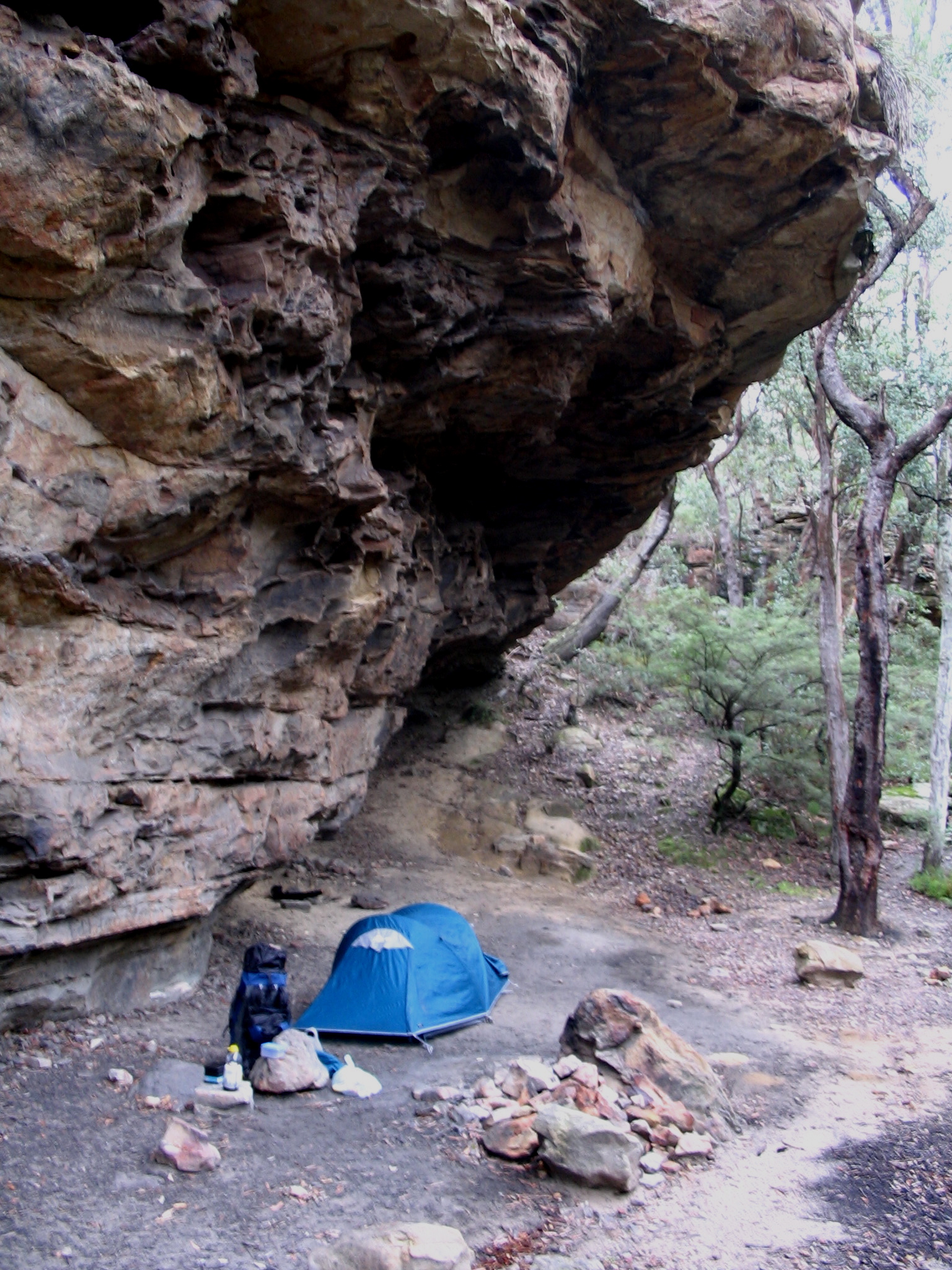
At some point the going-forward track dead-ended on the southern side of the mountain, but a small backtrack, some swearing and a steep hike got me to the first summit mentioned in the cheat-sheet. I pushed on for what felt like an age to Chinaman's Gully and set up under one of the underhangs. (There are truckloads of campsites on this route, complete with stone fireplaces.) Vodafone covered most of the walking trail, and so I spent some time nattering with Dave when the darkness properly kicked in.
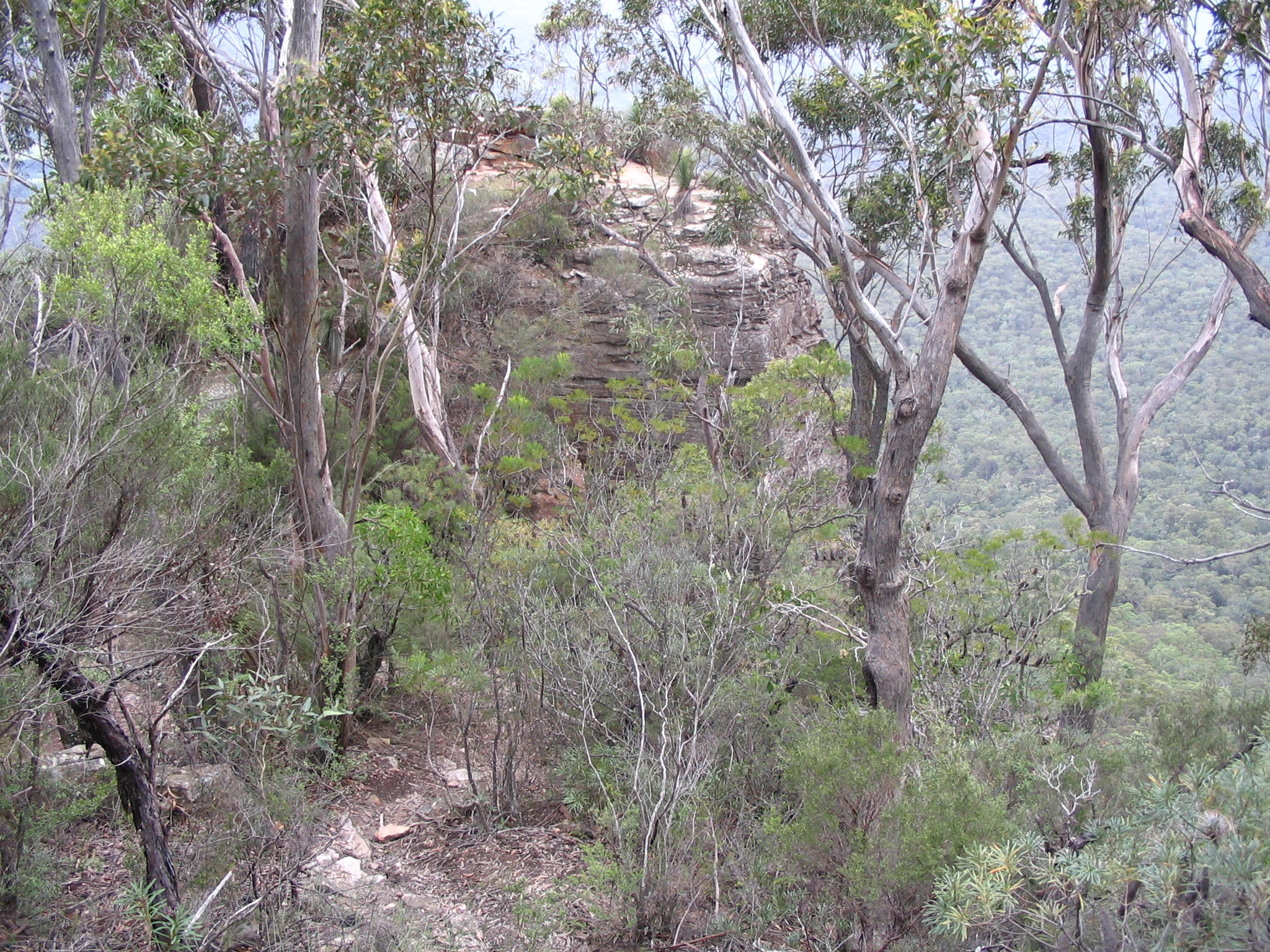
After a very slow start the next morning I had a pleasant walk along the ridge which had some great views back to Katoomba, though I couldn't see much of the Three Sisters as they stand in line, pretty much directly north. Indeed, the haze and rain put paid to any decent photos from this trip. The more adventurous or energetic could probably climb the summit with little trouble, but I was preoccupied by what was in the offing. Continuing to the Col I made my mark in the log book and contemplated the descent to the Kedumba River. Suffice it to say that yep, it's steep, but I reckon it was easier than trying to go back down the western side with a pack on.
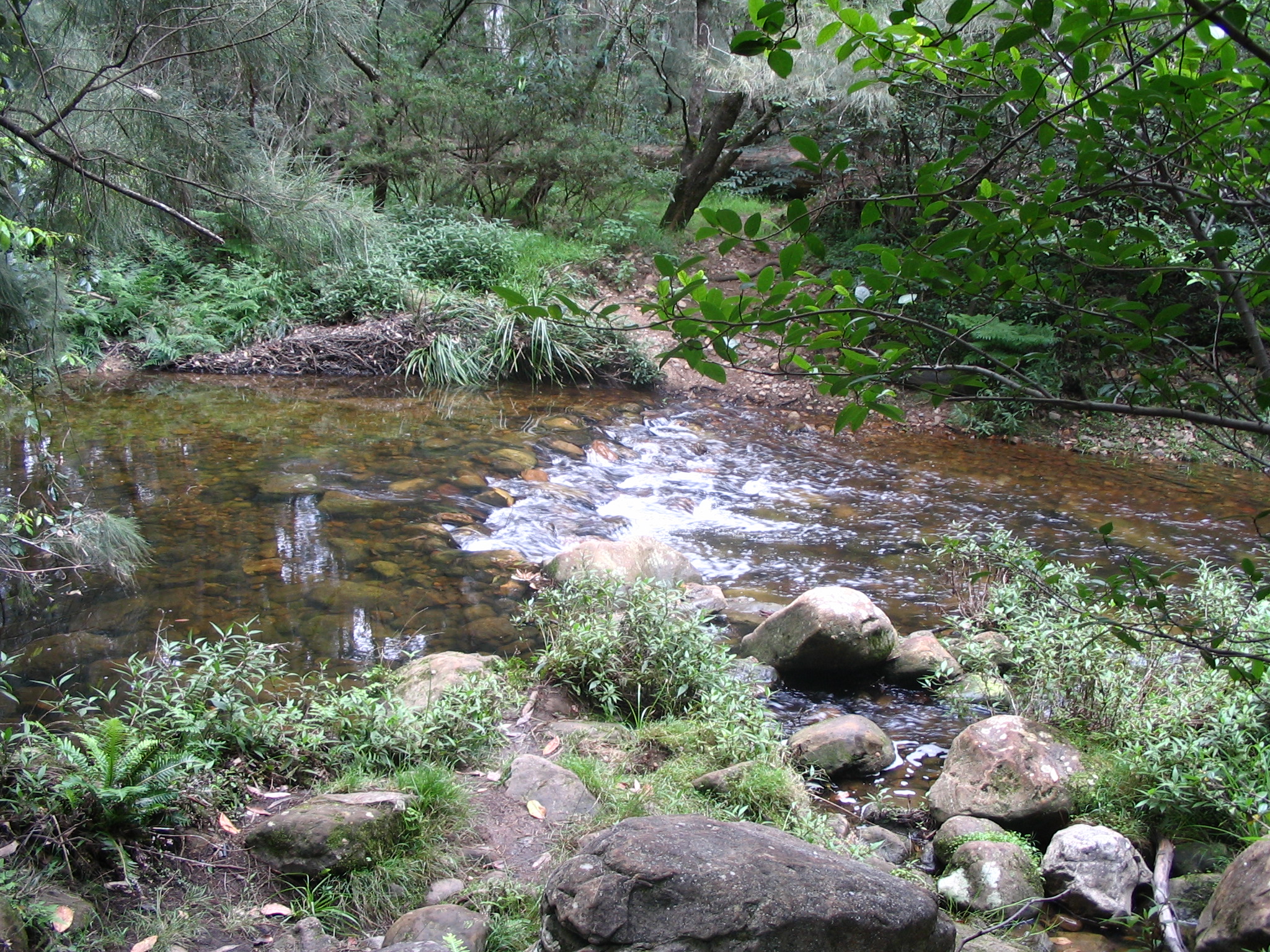
Again the rain started up while I was trudging along the Mt Solitary Walking Trail, abating by the time I got to the Kedumba River crossing. Due to the rain it was flowing quite rapidly, and I took the opportunity to refill my 2.4L Berri Apple and Pear Juice container (thanks, parents) and try out these water purification tablets. The result was some chemical-smelling but perfectly fresh-tasting water that didn't make me crook. Lunch was a Heinz Chunky Butter Chicken, which is just fabulous if you're eating to live. (Dinner had been their Rogan Josh.)
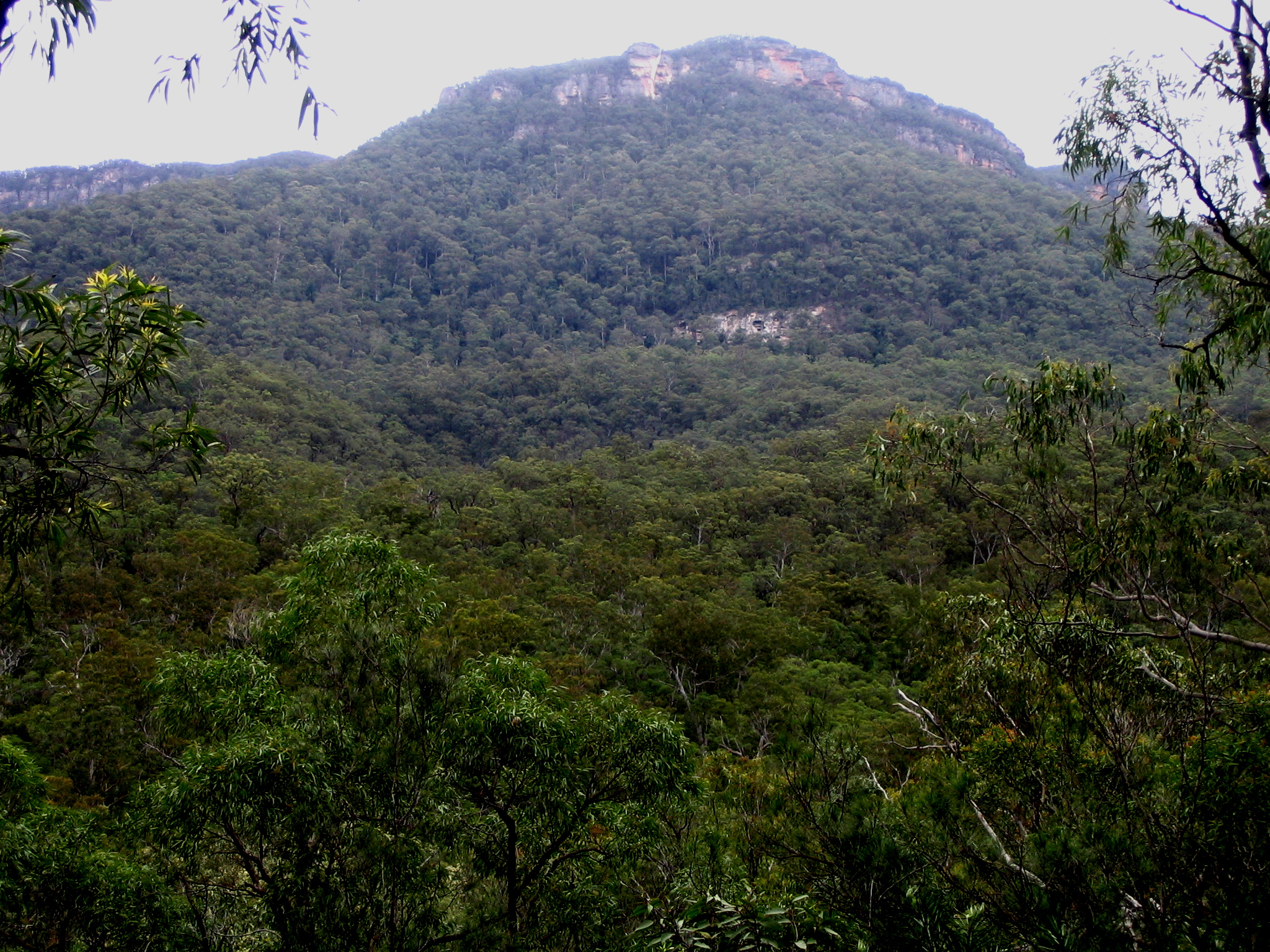
From the other side of the river the trail goes straight to a fire trail that leads to Kedumba Pass. An apple and a quarter-block of dark chocolate got me up the Victoria Pass-steep road in double quick time, arriving at the defunct Queen Victoria Memorial Hospital in something like an hour. I've got to find more things to do while I wait for my heart to slow down. The rain set in again, I was buggered and it seemed like a good idea if civilisation came to me in the form of an amiable cabbie. Had a beer at the pub at Wentworth Falls and was kept awake by the inane chatter of youths on the train back to Central.
In short: navigation was pretty easy, or as one guy remarked: "it's a highway". I had the Jamison Valley topo map recommended by the cheat-sheet; the Katoomba one is not very helpful as it only covers the very start of the trip which is signposted anyway. The views are great, especially on the southern side. The Docs are not the best hiking boots ever. Kathmandu really should make a big-as-can-be water bladder for their GluonTM system.
Iain is presently working at Kathmandu, and they're presently having a massive sale... ergo, I bought some gear. (The sale was a lucky coincidence, I was really there for Iain's expertise.) Here we go:
- A Vanguard v4 Rucksack with a daypack.
- A silk sleeping bag liner.
- A microfibre towel, and we'll see how much skin that takes off.
- A self-inflating mat
Suffice it to say I am well pleased. Now, to get all the other gear together... and see how far I can walk with it on.
A massive port of some of my old PLog entries led me to update the img plugin. Now it does some fancier CSS stuff. Enjoy.
CSS brokenness: The CSS gunk from some W3 style examples which works fine... if you don't mind your images flush left or right. Why is there no simple way to centre arbitrary objects?
Clive Hamilton and Sarah Maddison: Silencing Dissent: How the Australian government is controlling public opinion and stifling debate.
Tue, Mar 20, 2007./noise/talks | LinkA talk by the authours at Shearer's Bookshop in Leichardt. For mine the corrosive effect the Howard Government has had on Australia's public institutions is both its most important and most troubling legacy. Due to our general disinterest in matters civic, the manifest concern has been economic and occasionally social, rarely structural, perhaps because such things make few people relaxed and comfortable. I find this very irritating.
If one has a rough idea where these people are coming from (traditional liberal democracy, Westminster accountability, etc.) then I expect there is little that will surprise in this book. (I haven't read it yet, I'm going on past Clive Hamilton form.) One may then wonder what the point is in producing a record of the debasement of public institutitons if it will only be read by those who are worried in the first place.
(The authors were careful to note that the Hawke and Keating Governments also engaged in nepotism, neutering, playing favourites, etc. and spent a long time disavowing the "Howard hater" tag. Clive Hamilton made reference to Judith Brett, an academic studying the Liberals, and I think there is a lot they could learn from her about wrestling their way to the centre of the public political debate.)
John Pilger asked the final question of the night, asserting that the situation is not so very different in the other Anglo democracies. Clive Hamilton's response was that the democratic processes are much stronger elsewhere. I also think it's important to note that our party structures are so much more rigid than in (say) the U.S; from Peter Garrett of the ALP we get a toe-the-party-line cop-out, as if dissent on the issues that made him famous politically would be the most heinous and damaging act imaginable. The "broad church" of the Liberals can sometimes show evidence of an internal debate, but Howard is always calling for more discipline. Are people so scared of democratic processes?
There's a review in the Smage by David Marr. I note Peter Andren patronised the book launch at Parliament House, and that Marr will publish a Quarterly Essay in June this year entitled His Master's Voice: Public Debate in Howard's Australia.
There's a classic mix of Allen Ginsberg's America and Tom Waits's maudlin saxophonic Closing Time (from the album of the same name) that Dave got me onto back in the late 90s. So when I was in San Francisco back in 2004 I naively asked at City Lights Bookshop if they had any recordings whatsoever of the poet, expecting that the place that published Howl would have a shrine or something. No joy. I now find that particular song is an unofficial home-job, most lovingly crafted.
My nextdoor neighbour Jon is in this workshop ("Gala") performance of this new play, Codgers, alongside a raft of older Australian gentleman-actors. The gambit is to tell a story about the modernisation of Australia from the perspective of blokes who fought in the Second World War. It's quite funny and the semi-polished performance worked quite well.
Ross Gittins is the editor of the business section of the Smage and writes the occasional edifying column on economics. (Andrew Norton observes that he tends to alternate commentary on social policy with demystification.) This was the launch of his book, a distillation of (mostly other people's) wisdom apropos living a good, or perhaps even happy, life in an age of excessive consumerism and dearth of time.
Richard Glover was his partner in conversation, and was quite a bit sharper than I would have expected by his Saturday Smage columns, particularly when he was summarising questions for repetition through the microphone. We heard about an itinerant childhood, being the son of two Salvo officers, and much was made of the recent work in behavioural economics. I asked Gittins at the end if we would see a return to collectivism, and earnt a very Maynard-Keynes response: "Just wait, it will be back".
John Gall: The Systems Bible, The Third Edition of Systemantics.
Mon, Mar 12, 2007./noise/books | LinkFinally got around to finishing this one. It's a book to savour, though the newer sections are a lot drier than the sharply observed witticisms of the first two editions. From the preface to the second:
Things have never been better — but they're improving.
Problems are not the problem; coping is the problem.
The departure point is the insight that new systems mean new problems, married with the even deeper insight that there need exist a treatise on a general theory of systems that apes the lingo and pomposity of truly excellent academic work. I'm sure a lot of the concepts are treated formally elsewhere — feedback, for example, and the trickiness of making observations — and as such the book serves as a great overview of the field. Also memorable are the discussions of humans embedded in a system, the possibility of changing system behavior and the likelihood of success.
There's a whiff of the Vietnam War in the air, and it must be an election-year-of-sorts in the U.S. This movie also broods on contemporaneous events such as the murder of Martin Luther King Jr and the Prague Spring. It's not particularly subtle, with the sledgehammer implication that Camelot could perhaps have saved us all the mess between then and now. Chomsky, of course, disagrees.
The Fog of War: Eleven Lessons from the Life of Robert S. McNamara
Tue, Mar 06, 2007./noise/movies | LinkAn excellent doco on the top technocrat of the Vietnam War. In this instance Chomsky is right, McNamara does come across as a small-time manager/engineer charged with optimising the means of destruction, showing little concern for the non-American fallout.
Heroic Bushwalk: Cowan to Jerusalem Bay, and up to Brooklyn.
Sat, Mar 03, 2007./noise/beach/2006-2007 | LinkShelly drove Iain, Vicki, Eoghn and I up to Cowan, where we proceeded to take a wrong turn and needed to bushbash our way back to the pedestrian bridge over the F3. The walk from there down to Jerusalem Bay was not too hard, and it was a pretty spot for lunch and a swim. It's a semi-popular spot to head to on a boat, and somewhat strangely goes from half a metre to two metres very quickly.
As the NPWS website says:
Jerusalem Bay Track (to Brooklyn)
11 km, 4.5 hours, difficultThis track covers a small section of the 250 kilometre Great North Walk, which goes all the way from Sydney to Newcastle. Starting at Cowan station, take the steep descent through thick scrub, across a creek, past the ruins of Rhodes boatshed and on to the beautiful Jerusalem Bay. From here you can grit your teeth and head towards Campbells Creek and Brooklyn (where you can catch the train home from Hawkesbury River station). Expect spectacular views.
The "grit your teeth" stage was pretty exhausting, but at the top we found this section of the Great North Walk to be a fairly wide and easy firetrail. Bloody hot day, not at all ideal for such an arduous trek.
Here is a Google Map of the area. I'll see if I can plot a rough route and annotate the map... apparently this requires JavaScript, which is going to hurt. Mapstraction looks like it could save some trouble, if it doesn't cause more.
Update: on André's advice I had a look at tinymap.net, which does the trick. I'm too lazy to render this walk as polylines though.
First published as The Empty Raincoat in Britain.
I am not in the target demographic of this book. The style is chatty, presupposes a disposition towards competitiveness, material success and traditional (authentically conservative) values. This is philosophy for managers, low on empirical or even argumentative justification, expressed in inimitable corporate språk. Their let's-get-on-with-it attitude, even in the face of vague goals and the damage inflicted on larger or external systems, is perhaps what grates the most with me.
Even so, he's not bereft of ideas, or perhaps of synthesising other people's ideas, that one might hope will improve the status quo of capitalism. (There is a bibliography but the main text does not cite it.) Handy himself implies his goal is pre-scientific (p246):
... [Allan Bloom, The Closing of the American Mind] ... American college students, he observed, were not only lifeless and ignorant, they were reluctant to offer or to hold any opinions at all. People who thought that they were right in the past did terrible things as a result, therefore it is best to have no opinions at all. The only true knowledge is science. Everything else is wishful thinking. From that it follows that it is wrong to take a position on anything, worse still to try to impose your wishes on your bit of the world. A passive voyeurism will have to suffice, preferably uncritical and politically correct because it is wrong to suggest that any one way of life is superior to another.
I tend to agree with him here, largely as I have found discourse on ideas largely absent in my university experience, especially between the faculty and student bodies. From my perspective it might help if the profs remember that they were once naive and that formalisation may better come after the idea or intuition, not before. I'm sure they have corresponding advice, unarticulated, for the students. Handy says (p218):
Portfolio workers need more than agents, they need somewhere where they belong. Learning is alienating if you do it all by yourself. Teleworking is fine in theory but lonely in reality. That asset which is yourself can atrophy is isolation. ...
Wow, only thirteen years later this has come to pass.
Handy's "inside out doughnuts" with "cores" and "empty spaces" (p69) reeks of a desire to have a diagrammatic shorthand for an ill-formed concept. NICTA's logo must be a sophistication of this idea:

A quick stab at Handian analysis would be to say that NICTA has two self-identified cores (permanent staff, intellectual property?), one centred and the other overlapping the big don't care (?) space, there is an anonymous auxiliary core-like thing (???), and that they feel ambiguous about their empty space (non-permanent staff, students?). I think there's scope for a profitable new form of logo analysis based on these insights.
Similarly the corporate social contract is hexagonal (p165) though the traits tend to be enumerated in the rank order that reflects a particular corporation, or nation-stereotypical corporation.
The apparently enduring Handy classic, the sigmoid curve (p49 etc. etc.), is a strange one. (See here or ask Google.) The focus is on the second hump, the bit where we have overmilked the cow. Sure, I'll buy that, but little explanation is given for the initial downward dip. For it to encompass relationships as well as business I would have to think that before I enjoy the company of a significant other, first I must suffer. Perhaps he is talking about capital, not success, or maybe the early stages of a "successful" relationship puts a crimp on his liberty.
Why carp about his iconography? Well, as my friend Sus says at the end of every email: "Confusion and clutter are failures of design, not attributes of information." (Edward R Tufte)
To move onto perhaps more substational criticism, Handy has a habit of being a bit wrong with some of his examples. Apropos the computer industry, he claims (p20):
... In theory, anyone can be intelligent in some way or can become intelligent and thereby have access to power and wealth. There is little to stop a small firm muscling in on Microsoft's territory just as Microsoft did to IBM. When the key property is intelligence, you do not have to be big or rich to get in on the act. It is a low-cost entry marketplace. It should make for a more open society.
I'm sure Netscape would agree wholeheartedly with him, and they sure weren't small in the mid-90s, soon after this book was published. Moreover while I would concur that the cost of entry to the information processing market is low, the end result seems to be Google, i.e. a de facto monopoly. (A general criticism of capitalism seems to be that it tends to oligopoly, in which case his faith that low entry cost implies a more open society is misplaced. By way of evidence I offer up the state of the car industry in the U.S. and otherwise pass the buck to Google.)
Also irritating is his enumeration of "intelligences" (p204) which actually reads more like a shopping list of talents or skills. I don't think of Shane Warne's bowling action as physical intelligence any more than I elevate a pain reflex to the status of a thought. I do grant that Warne is a cricketing genius, but not merely because his fingers have been taught how to behave.
My carping could be endless, so I will stop after just one more: his response to "what is the point of it all?" is (p245):
... We are all accidents in the evolutionary chain. We can lie back and enjoy it, or we can occupy ourselves, as scientists do, in trying to understand more about what is going on. There is nothing we can do to alter it, even when we understand it. We can only play with it. Man is as the smallest piece of dust in the universe. ...
I find this fatalism misplaced and irritating, perhaps because engineers are charged with altering things. In any case, Systemantics treats this issue more broadly and insightfully, and with more humour.
On a more agreeable note, he does propose:
- A decoupling of credentialism from age, allowing for the differing rates of individual maturation;
- A proper mutual obligation scheme, the "double bond" where the state pays for education and employment for a limited period with the intention that these be learning experiences that repay society in the long term;
- Decentralisation of control in companies.
...and many more. I guess I'd prefer to read something more factual and logical.
Gernot has had this quote on his homepage for as long as I remember:
The first step is to measure whatever can be easily measured. This is OK as far as it goes. The second step is to disregard that which can't be easily measured or to give it an arbitrary quantitative value. This is artificial and misleading. The third step is to presume that what can't be measured easily really isn't important. This is blindness. The fourth step is to say that what can't be easily measured really doesn't exist. This is suicide.
I've tried to source it. Of course "McNamara" is Robert S. McNamara, famous for his attempts to run the Vietnam War on "rational" grounds by, for example, seeking advice from game theorists. As for the words themselves, I can only find them expressed in Charles Handy's The Age of Paradox (p221, 1994, first published as The Empty Raincoat in Britain).
Free wireless at the Verona café. What a great space for lurking.
This is a lot less violent but no less graphic than Flags of our Fathers, with a focus on the effect of decreasing morale amongst the Japanese forces on Iwo Jima.
Mid-afternoon dip with Jen at the Redleaf Pool at (the eastern bay of) Double Bay. In no sense is it a proper sea pool such as one might find at Coogee; it's simply a bit of beach ringed by a (shark proof?) fence, containing two pontoons. I reckon we saw a tiny little stingray (perhaps a foot wide) just near the sand. The coffee shop there is top-notch, and parking is free and plentiful.
Googling for "Red Leaf Pool" makes me think the place is perhaps most famous for the public facilities it provides, listed in the National Public Toilet Map. I am both surprised by the existence of the website itself and that there are still free public facilities in Sydney at all. Perhaps this is what all the pay-to-pee money goes towards.
I was a bit shocked to see that infamous smirk on the news telling anyone who might organise or encourage a boycott that they may face damages for doing so. Would this apply to the Green Bans? You can bet your animal-product-free underpants it would, but the article makes it clear the existing laws already did.
I'm not sure what the limits of these new laws will be (sometimes being a lawyer would be most helpful) but I speculate they must also apply to Linux and Free Software proselytisers pushing a "Boycott Microsoft" line. Does it matter if one pays for an equivalent product, or is the word "boycott" a sufficient trigger? What about encouraging the free downloading of Debian, is that costing someone a sale? How about a system for "boycotting" ads on time-shifted TV?
The key observation is that, like the industrial relations laws, the government increases its discretionary role in this process. Rather than leaving it to the courts and (say) the National Farmers' Federation, we have the ACCC organising and funding the actions. Fair? Of course! Farmers are doing it tough. Heck, even Channel 9 is doing it tough. Remember everybody, have three kids and make sure they eat a pig at each and every meal.
As with Leonard Cohen, John Lennon is best when he's doing the talking and singing. This is partly a warning about political interference in the INS but mostly hagiography from talking heads. The boomers will love it.
On the topic of political protest about Vietnam in the late 1960s, I thought it's time I watched Martin Luther King Jr's I Have a Dream speech in full. Contrast it to current political rhetoric (did I hear Kevin Andrews roll out the tired old "We decide who comes to this country and the manner in which they come?") and despair. Heck, even accountability is rare, and I find Nixon's resignation speech unthinkable now.
A collection of short stories. I enjoyed her effort in the Big Issue and so managed to extract this book from the chaos that is the UNSW Library undergoing massive physical reorganisation.
I think the Western Australia Premier's book awards reviewers more-or-less nailed it:
Proudflesh is a collection of coolly cynical stories about the contemporary world, concerned particularly with connections and relationships between people as well as their foibles and stimulants. Its range of interests is wide: popular cultural forms, psychology, addictions, missed connections, love, obsessions, loneliness. Most of these stories have a sharp edge; the writing is always controlled and self-consciously literary.
It's the last bit that kills some of the stories, the self-conscious literary style, the substitution of enumeration for description, the invocation of a name that connotes all to her and naught to me. Still, as David Malouf ably demonstrates, writers tend to begin like this and amble towards naturality.
Memorable:
- Consuming Passions (I and II). These are character sketches of two women whose lives happen to intersect in London, concluding in a rather lamely observed powerplay.
- Living Arrangements, an easy-come-easy-go entanglement. I couldn't help but compare it to David Malouf's Every Move You Make (from the recent collection of the same name), similarly told from a woman's perspective.
- The Human Kiss, a tale of a woman moving in with a man with kids, one of whom has a heroin addiction. The portrayal of split loyalties is excellent, though the drug theme is fairly standard and unenlightening, somewhat like Helen Garner's efforts without the levity.
The title story, Proudflesh, is available online.
UNSW Alumni Brainfood: Professor Michael Archer, Dean of the Faculty of Science at UNSW on fossils.
Wed, Feb 21, 2007./noise/talks | LinkThe UNSW alumni association has been organising these talks for a few years now. I thought I'd give it a go, partly because of the topic:
Professor Archer will present a fascinating discourse on Australia as the home of the world's biggest, weirdest and oldest fossils. Hear all about flesh-eating kangaroos and bizarre creatures that go back to the dawn of life on earth.
but mostly due to idleness. Yep, he described all kinds of weird ancient creatures, mostly at a level that would impress a primary school student. More interesting were the implications he drew from the fossil record, such as the relative success of marsupial and placental animals and the possibility of human inhabitation of this continent going back millions of years (and not just thousands). Political sensitivity made him pull his punches on the latter, unfortunately.
These stories of empirical science — the field work, the cross-discipline collaboration, arguments about the balance of probabilities, the broad interest in the results — make me realise just what a weird field computer science is.
When I started at UNSW I didn't go to O Week, and I guess that must have scarred me for life. Tales of all-night booze ups, predatory behaviour and insane yellow shirts in jumping castles only come second-hand to me. Anyway, I found it wryly amusing that CSU has disallowed the political parties from having stalls. Back in my day, it was the Christians that clashed with the powers which protect the youth from sullied minds.
Circa 1994 or 1995, Campus Bible Study (CBS) wasn't registered with CASOC (the Guild's Clubs and Societies coordination and funding committee) for reasons unbeknownst to me, and so some wags got together to register CBS, the Children Born of Satan, inaugurating their club by sacrificing a watermelon on the Quad lawn. The O Week rules were that only CASOC-registered clubs can approach the mobs of first years and solicit their membership, and there was a lot of rumbling about the lack of teeth in CASOC's response to the unofficial CBS, whose actions were deemed predatory and unseemly by many. (I grant there may have been some anti-Christian sentiment in all that, but some rules were violated as I recall.)
Anyway, this got resolved some time in the late 90s when the officially registered CBS folded and the CBS as we know and love it got CASOC approval to do what the hell they wanted during O Week.
(By all means correct my faulty memory in the comments.)
... and it seems the answer to whether Sydney Uni has an O-Week is now a definite yes (whatever it was before).
At the Verona with Jen. Structurally this movie is quite similar to Per Olov Enquist's fictional historicism The Visit of the Royal Physician: they share the mad kingpin, the handsome physician besotted with a/the queen, the refraction of the story through a physician-as-intimate-and-trusted-advisor prism, the betrayal of the initial ideals of improving the country and the acceptance of the omelette doctrine. Abstractly we see the struggle to throw off the imperial yoke degenerate into quite another sort of fiasco, and the bloodlessness of the English establishment. Forest Whitaker is excellent, and I'd only quibble a bit about some of the signature FilmFour camera work and editing.
Suffice it to say that if you liked one you'll probably like the other (though the book requires some patience).
Again, not one of his best novels. The humour is droll, dry and melancholic, with some "jokes" stretched from the start of the book to the end. These are the jokes that life plays on you, not the ones that make you laugh. Conversely there are flashes of gentle humour, particularly apropos his eternal fascination with the Communist mindset:
You smile as though you were thinking to yourself.
Being his first novel he attempts to do everything within it, and his characteristic authorial interjections are lamentably absent. Indeed, one feels that Kundera's life to that point (the mid 1960s) is a variant of Ludvik's (p170):
... I had begun my own research almost ten years later than my colleagues — I had still been an undergraduate in my thirties. For a few year I had tried desperately hard to bridge this gap but had then realised the futility of devoting the second half of my life to a pathetic chasing after lost years, and so I resigned myself to it. Luckily this resignedness had its compensations: the less I chased after success in my own narrow field, the more I could allow myself the luxury of looking out from this field on to other areas of research, on to man's being and the existence of the world, and could experience the joys, among the sweetest there are, of speculation and reflection. My colleagues, however, knew full well that if such contemplation gives a man personal pleasure then it is of little use for a modern scientific career, which demands that the scientist should burrow zealously in his own field or sub-field like a blind mole and should not lose time lamenting lost horizons. For this reason my colleagues half envied my resignation and half despised me for it, as they gave me to know with gentle irony, calling me the institute's 'philosopher', and sending me journalists and news editors from the broadcasting company.
The book is essentially about change and capriciousness, mutating loyalties and the unknowability of others. He revisits some of these themes in his later (and to my mind, more successful) novels, painting less dire images of how life slips out of control.
The translation of this one has apparently caused him grief over many years. I read the original butchered translation from 1969.
burn FAST burn BRIGHT
Post Political Smoking: Is Tobacco the Heroin of the Next Millenium?
Ruby E. Royal
It is happening again. In backstreets and alleyways, schoolyards and bedrooms, the pungent aroma of smoking tobacco is staging a comeback. Faced with the hassles of maintaining expensive smack or crack habits, junkies and drug afficiandos alike are rediscovering the joys of tobacco. The number of young smokers is actually increasing despite increased awareness of smoking and its bundle of assorted dangers. Mainstream persecution of smoking has made it such an uncool and distasteful pastime that it has paradoxically renewed its rebel appeal and counter-culture chic. Demonised by scientists, the media and recent government anti-smoking campaigns, tobacco is looking to be the dope of choice as we head into the new millenium. Smoking 'schwag' has become an act of nihlism and disinterest, the perfect vice for today's cynical, disaffected youth. It's strengthened status as 'fringe activity' has turned the famous convivality of the 'smokers bond' into an emblem of cultural identity, of solidarity between disparate individuals. Whispered with the conspiratorial urgency of any secret society, the knowing looks and loaded subtext behind "Got a light?" have made it the definitive pick-up line of the century.
Marijuana is passe, it dulls the senses and carries too much hippie baggage for today's forward looking radicals. The new-wave of nicotine-surfers describe a high that is more intellectual than physical - a euphoric experience of freedom sourced in a rejection of contemporary social mores. In lighting up, they are saying "Whatever!" to an increasingly confusing and catastrophic world. With antagonistic relish and odious selfishness, the new smoker partakes in the sadistic pleasure of tormenting their oppressively moral and puritanically rational non-smoking neighbours. This determined refusal to surrender personal desires to those of the consensus, has canonized smoking as an individualistic and life-affirming assertion of "I am here, watch me breathe!" - a triumphant display of being able to do whatever the hell you want, despite the controlled and regulated environments we live in. The "Bring 'em on!" attitude of famous chain-smokers such as John Wayne and Dennis Leary appeals to universal desires for empowerment, re-investing the atomised individual with the freedom to flaunt the tyranny of 'common-sense' and to give the finger to mainstream opinion.
Vices are pleasurable because their irrationality lies closer to the essence of the human condition. Consequently, each cigarette offers the individual the heady rush of invulnerability that comes with sucking at death's nipple - the ultimate disposability of life personified in a symbolic gesture of confrontation with the infinite. With each drag the modern smoker is saying "Come on death! I'll take you on, but on my terms." The very damaging properties of tobacco supplied as readons for not smoking have instead been turned on their head and incorporated into the smoker's philosophy. Lung cancer? Heart Disease? Death? "That's the whole point!" they exclaim, "It's death at your disposal!"
This cynical god-complex has proved popular with kids facing another seventy years of fatalistic existence in a world plagued by serial disaster. The traditional anti-smoking reproaches such as "Each smoke takes five minutes off your life" fall short of Generation Me's gritty social realism. With black humour they reply "As if I'll get a root in the last five minutes of my life anyway!" The trade-off is alluring - increase the intensity of youth at the expense of decrepit old-age - live fast, die young, and leave a beautiful corpse. So what if smoking is a filthy habit? That's half the attraction for a generation which has embraced the trash aesthetic and junkie culture as more than a pastime, but a way of life.
A whole philosophy has grown up around abuse and excess, colonising our pop-culture and collective consciousness as evidenced by the long list of famous addicts-for-their-art and substance-martyrs. Models, actors, rock stars, painters, writers - anyone with any talent appears to be hooked on something. It's not hard to see why every little boy and girl wants to appropriate an addiction for themselves. The problem is serving them all in an orderly and efficient manner. Hence cigarettes - habitual, easy to manufacture, but above all, bad for you. You don't need to be intelligent to do them, there's no messing around with needles or teaspoons, mirrors or razors, no risk of flashbacks or overdosing. It's Russian Roulette made cheap and easy. Unlike their predecessors, who had to indulge their escapism covertly and illicitly, the nicotine addict has the advantage of being able to score almost anytime, anywhere, from newsagents, supermarkets, even petrol stations! Tobacco is also retro enough to claim a mythology of its own; as an appetite suppressant it keeps you thin at the same time as giving you the voice of a blues singer! No wonder it's being hailed as the perfect drug.
There are certain rules to be observed with any addiction however. 'Nicking' (a cute tag for nicotine withdrawal) is taken for granted - it's what you do with it that counts. It's not enough to get the shakes or fidgety fingers, the enlightened smoker must convey the deeper meaning behind voluntary dependency, a recognition of humanity's tenuous place in this impassionate and unpredictable world. This is the age of the masochist, the martyr, and smoking is the most favoured choose-your-own-noir adventure. In a nihilist world, tobacco is the nihilist's choice. As any hardened smoker will gladly explain (between drags) "Smoking kills? Oh tell me something I don't know baby. The entire boat's sinking and if you want to drown in your seat that's your choice. The world is fucked and every one of us is dying a little bit each day, so you may as well choose your own exit, and enjoy yourself while you're at it. I'm gonna roll my way to heaven, up there in smooth clouds of ready-rubbed Class A. You have to respect that. There's nothing more infantile or prudish than the limp-wristed crowd of puritans making exaggerated hand gestures and gasping like beached whales. Don't they know the three great consumptive pleasures in life - sex, coffee, chocolate - are all made better with a good smoke? Smoking is everything. Smoking is the light at the end of the tunnel, through which the world is going to hell in a handbag. We're all blindfolded prisoners in front of the firing squad see? Any last requests? Well yeah, gimme a smoke."
This article won the author a creative writing competition at UNSW sometime in the late 90s.
![[Fade to Beige]](http://peteg.org//static/FadeToBeige.jpg)
...the bland leading the bland down corridors of beige...
As this campus is being reconstructed into a super-uni where only the biggest and fittest faculties survive, its intellectual and atmospheric properties are being coloured over by the blue and beige paint. Soon students will have to walk around in uniforms, differentiated by symbols emblazed on jackets representing the faculties to which they are allowed to belong. The upside down tree, once located near the construction site outside the architecture building, was a statue of hope in the milieu of indifference. It represented a moment of mother nature's turmoil and the possibility of recourse to sameness. A tree that meant more in death than in life. In its non-existence we have been left with a cenotaph parading as a Library. 'UNSW RIP' it barks at the city of Sydney.
Colour is where this campus is at. As life has ebbed away from campus 2052 colour has been the flotsam that has surrounded the island of the chancellery. Well, to be closer to a truth, it has been the jetsam ejected froom all aspects of campus life, be it political, emotional or edible. Soon all the dye will be drained from the most resplendent icons on campus, and what will be left? exactly what was there in the beginning - sameness. A void... avoid.
<fade out to flashback>
A naive middle-class 17 year-old boy arrived at Eddy Avenue in the early part of 1990. He was ready to be transported through the corridor of Surry Hills, this time by a blue bus and not the family volvo going to the Easter show, along the leafy parades named after our beloved ancestors to finally reach an institution that was surrounded by spike-topped fences - to keep them in or keep them out? We all wondered.
It was a warm summer's day as hundreds of greenhorns stepped off the 393 to be greeted by people bathed in yellow. More happy to see us than our parents at our birth, the colourful fuckers yelled in unison, "Follow us! We will show you that there's more to uni than studying." Wow, we all thought. You can be cool and have fun too at Kenso Tech.
After hours of lectures that made you feel like you just re-entered year 7, the yellow coated jellybeans dragged you around campus espousing myths like this place is better than Disneyland. Geeze, does this site of ugly brick buildings and as little grass as the CBD situated on a fucking hill have a soul? What else would drive fifty or so students to wear the same t-shirt for a week just to show a bunch of freshers around? Answer: the bar.
Does Sydney Uni have an O-week? Or more importantly does Sydney need an O-week? For some reason UNSW feels like the life is dripping out of it. It is being slowly suffocated by an overdose of sameness. The yellow shirts, in all the naive glory, try to stop this institution without a soul from sinking deeper into the depths of beige. They ought to be congratulated for their effort, but it was doomed from its inception.
<fade to present - vaseline lens>
Ah Esmes, the last bastion of intellectual and spiritual life remaining on this campus. Imagine crusty orange chairs encapsulated by booths. To get out of them you had to climb over people and mind their coffees. So old and cruddy was the furniture and the carpet that you felt, or well I felt, at home. Searching for the pile of disposable ash trays amongst students pretending not to be as bourgeoisie as their parents you felt a company (even with total strangers). Is this life? Was this spirit? I don't know. But it was a melange of shitty short blacks, intellectual diversity, difference and acceptance. The cappuccinos always had a filthy froth and the film on the long blacks was the envy of Cecil B. de Mille. Thas was then, but what about now?
The Union, to which you pay $181 a year for food, entertainment and yellow shirts (yes, I know that the last two on the list can be considered one and the same) renovated Esmes (you call neon signs, plastic plants and faux wrought iron chairs renovated??? - eds) when it was where Badabagan now is and then moved it to where it is currently. Better view. Better coffee. No atmosphere. Is not the University Union, to which the students elect the board members, responsible for the lack of colour on this campus? Is it possible that places such as the bar and Esmes are lifeless because the people who control and run them treat students and stadd as a homogeneous mass who are to be treated like sheep about to be shorn? It's as though a bunch of them sat in a boardroom and said "Let's give the masses the illusion that they have control over their consumption - 10% off if you show your student card, that'll placate the non-believers." Soon the uniform of the Union lackeys will be that of beige and not of hypocritical yellow, and beige coloured lattes will become the portion controlled beverage of UNSW inc. Only the radicals willing to be outed will dare to order a short black.
The Student Guild though has been moderately active in responding to this campus' fading into beige. One could suggest that they are partly responsible for the bland out of this uni, I mean they wear beige shirts accompanied by only the merest splash of purple (or is it mauve?), and they have certainly been complicit in the creeping conservatism. Then if you look at the percentage of people who actually get around to voting in Guild elections then you see that 90% of students are participate in a form of passive euthanasia - they are helping to kill their own environment. The rave on the lawn earlier this year organised by the Student Guild and the politics behind it (temporary autonomous zones) was a shining light in a very dim fog and should be embraced as a method to respond to the blanding out of UNSW. It made me feel that I was being confronted by new ideas and experiences; and having fun at the same time. All colours of the rainbow shone across the campus that day.
"Why has thou forsaken me?" yells the spirit of this campus. Or is it the cry of St. George campus students to the self-made God, John Niland? What difference does it make as this university moves towards a metaphorical crucifixion, not to rise again in three days, but to fade to beige.
toothpick
This article appeared in deaTHARUNKA (issue #14, '96), the student rag at UNSW.
Not one of his better novels from this vantage point of the twilight of his career. The timidity of his characteristic authorial interjections brings nothing to weak and cliched characters and plot. Clearly he lacked the courage to just run with it, to make the novel respond to his whimsy in the facile and melancholic way that made his later work so much greater.
The text is replete with the vaguely amusing contradictions of communist propaganda, e.g.:
"Revolution in love" - would you mind telling me what you mean by that? Do you want free love in contrast to bourgeois marriage, or monogamy in contrast to bourgeois promiscuity? [...] that can be put much better: "Long live socialism, long live the socialist family!"
Perhaps most disappointing is that his attempts to skewer the Czech communist regime lack his later dexterity and indignation.
(I read the revised original English translation by Kussi.)
Finally got around to reading Barry Schwartz's book that fleshes out his excellent talk at Google. It's a well assembled melange of ideas organised around the gap between what economics promises to optimise (property, wealth, choice, income levels, education, ...) and peoples' wellbeing. Yes, you'd be right to call it a self-help book, albeit one with a lot of academic citations.
I hope to go through this book again in the near future and tease out some of the arguments over on the wiki.
On a related note, an article by Daniel Kahneman and Jonathan Renshon, Why Hawks Win.
"Everything reminds Milton of the money supply. Well, everything reminds me of sex, but I keep it out of the paper," wrote MIT's Robert Solow in 1966.
The Big Issue #269 (26 Dec 2006 - 16 Jan 2007): Summer Fiction Special
Sun, Jan 28, 2007./noise/books | LinkThis one is wall-to-wall short stories, some quite good:
- Linda Jaivin: Jaklyn & Lucinda (subject-aware voyeurism).
- Mark O'Flynn: Stealth: Fire, Explosions, Death, Catastrophe, Screaming, Crashing, Destruction. And that's a wrap. (Hollywood goes to the Megalong Valley).
- Deborah Robertson: Seeking Jasmine ("I like sad girls.").
- Cate Kennedy: Ashes (a ceremony at a lake).
- Michel Faber: Adopt a Tiger (homelessness).
- Emily Maguire: Dependence (internet dating).
For four bucks and a conversation it's a steal.
I got a few doses of blog clap, and being bored and idle I put some effort
into tidying up Blosxom's venerable writeback plugin and
adding Captcha support. (I don't believe in the centralised blacklisting
epitomised by akismet, it's too readily
abused.) I get the impression that somebody in ee land is
manually spamming, so I might need a plan B. My other concern is that the Captcha times out, meaning that if you take longer than a day to go from
page load to post-comment it will bugger you up. Also the interaction with
the back button is less than ideal.
- 99writeback (plugin)
- writeback (flavour file for writebacks)
- writebacksform (flavour file for the writeback form)
You'll need to instruct CPAN to install Authen::Captcha (or
use your package manager to do it for you, or remove those bits of code). It
should be easy to adapt it to
use another Captcha library. I'm thinking
about constructing a logic-puzzle one.
Part way through I realised just how fragile Blosxom is (no non-word characters in directory names? — and I was going to call this writeback++!) and how badly coded most plugins are (let's do everything ourselves! date functions, interpolation, file-backed databases, ...). If my perl was more fluent I'd have a shot at linting it all.
Drove into Swan Hill with a hankering for some Maccas hotcakes (pancakes) for breakfast only to find they remain Maccas free. Settled for some pricey bacon, eggs, two coffees and an orange juice from an wannabe upmarket café. The waitress-barista at least had the pride to diss me for trying to explain a macciatto to her; in my defence I observe it is still short-or-long-macciatto land and she didn't get it right anyway (not quite enough cold milk). Better than the typical mini-cappuccino in any case.
After that I headed back to Orange to visit my parents for a bit. Took all day, about 600km through Deniliquen (bought some honey), West Wyalong (a coffee), Forbes, mostly signposted at 110km/h on single-carriageway highways. It is strange to be driving on the roads I learnt on as they are indeed as bad as any of the others on this trip.
Day 13: Mildura, Robinvale, Nyah State Forest, Murray River.
Mon, Jan 22, 2007./travels/2007-01-GOR-Murray | Link
Blue skies once again, hope the rain made it to Orange and further east. Had a quick swim in the morning. The Murray River is quite placid at this point in the Murtho State Forest. Strangely enough there were a veritable forest of succulents just next to the access road. Views from Headings Lookout:
Drove to Mildura, about 150km along the Sturt Highway. It's still 110km/h even into Victoria, but drops back to a Victorian (and NSW) standard 100km/h east of a little farming town near Mildura. The lady who served me lunch said she hadn't been asked for a Neenish Tart for several years. Mildura itself is a not-too-exciting relatively big river town on the right side of the border. The Sturt Highway slips briefly into New South Wales between Mildura and Robinvale, where (shouldered, single-carriageway) it returns to the breakneck 110km/h through endless mallee.
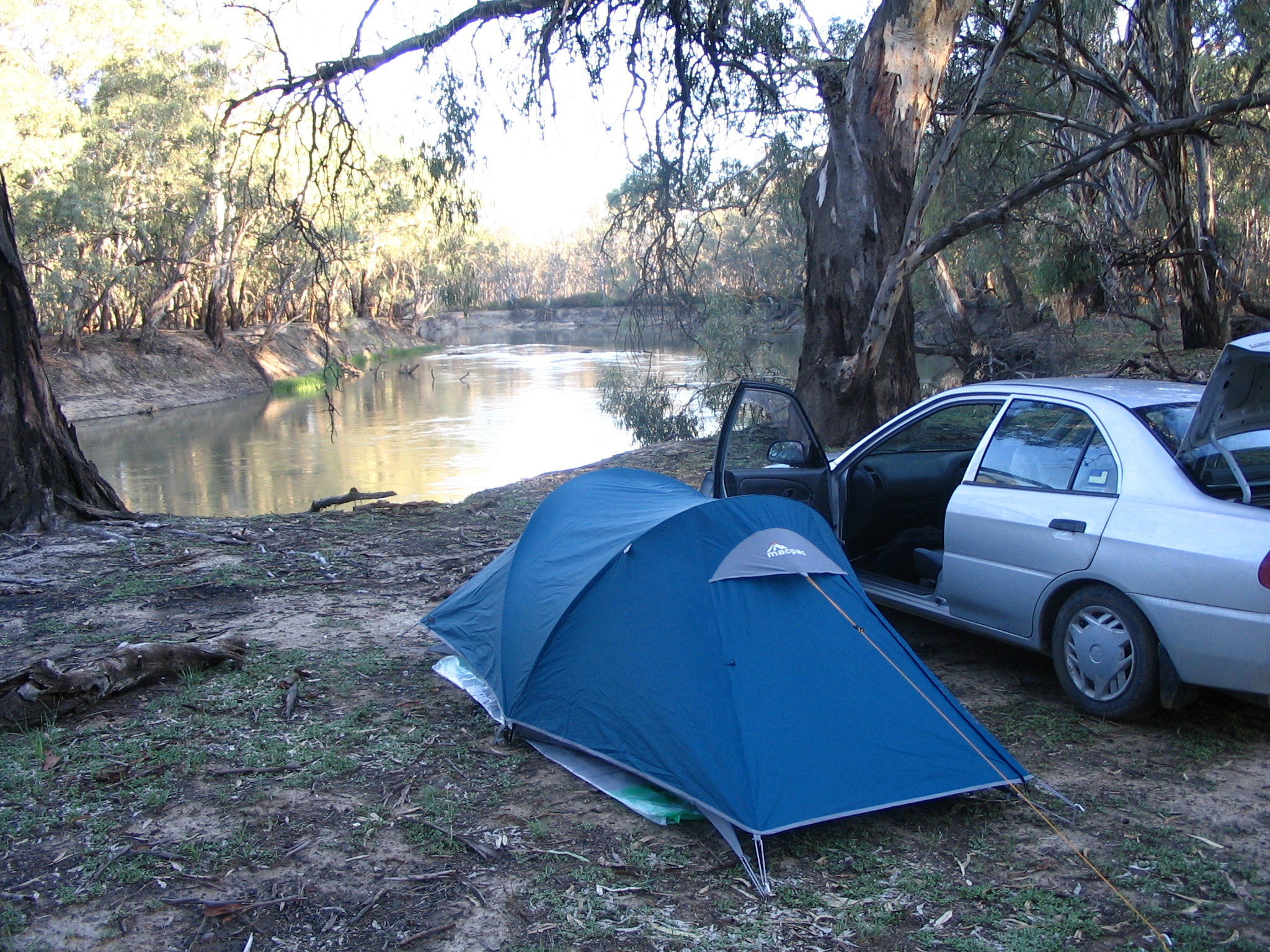
Got some water from the friendly CFA in Robinvale, drove on to the Nyah State Forest, near Swan Hill, for a late afternoon swim and to camp for the night. The river is fairly strong here so swimming is hard work; fortunately there are quite a few tree limbs in the water to hang on to, or even sit on. There's plenty of Major Mitchell campsites along the Murray Valley Highway, including one at the point were the Murray and Murrumbidgee join.
One thing I've failed to learn about campsites is proximity to the highway. Here I'm a good half-kilometre away but the trucks' noise covers that distance easily. Another is proximity to the township. A bunch of people decided to have a small party in the bush tonight. Fortunately they were not from a hoop-cutting tribe.
My only major criticism of the Camping in Australia (Cathy Savage, Craig Lewis) is that it splits things up by state and region, so when trying to find a campsite e.g. near the Murray River one needs to check about three different maps that are not cross-referenced. Similarly I tend to grab too many of the otherwise-excellent Parks Victoria information sheets as I cannot readily determine if they are about where I'm going or where I've been.
(In case anyone is wondering about the car, tent and river photos: there was a restaurant in Göteborg — "the Thai place" on Eklandagatan — that had a truckload of beautiful landscapes with solitary mysterious tents in them.)
Got up at 8:30am New South Wales time, had breakfast and did my laundy at the hostel. I asked the guy at the front desk whether it was worth heading back down to Murray Bridge and Bordertown rather than up to Gawler, and he gave me an emphatic "nope". Expanding, I told him RJL Hawke was born in Bordertown and they'd built a commemorative museum. He responded, "Well, if you go looking you'll find something, but most normal Australians would say there's nothing to see."
Had a second breakfast with An at Passatempo on Gouger St, near Chinatown. Adelaide doesn't really get moving until at least 11am on Sundays, which An reckoned was much better than Perth. We walked over to the info centre on Rundell St and I got the same advice as before: don't stop, head for the border. I think one needs good reasons to be in South Australia.
Just in time I remembered being told that the Botanic Gardens were worth a visit, so An and I drove over there and plodded around for an hour. Indeed, they're very beautiful, so much so that they need to rein it in with News Ltd. sponsorship of the lushest fig-lined corridor. The refurbished Palm House is full of amazing Madagascan arid-climate plants, and the nearby cactus and succulent outdoor bed is pretty cool too. Drove around North Adelaide a bit, where there's not much to see apart from some very fancy houses. We had to do some detouring to avoid the last stage of the Tour Down Under. Headed up to Mt Lofty in the Adelaide Hills but couldn't see anything due to a thick mist. (Come to Adelaide, it's winter in summer.) Dropped An at the State Library and made for the Sturt Highway, to Renmark. It's easy to drive around Adelaide but precious few places to drive to.

Approx 300km drive to the campsite in the Murtho State Forest promised by Camping in Australia (Cathy Savage, Craig Lewis). Very peaceful, no facilities. The river is very pretty around here. There are loads of vineyards even this far north.
Crappy weather all day, but the clouds broke in the evening.
Drove on to the River Port of Goolwa, the (purported) eastern gateway to the Fleurieu Peninsula. If I'd done more research I would have known this is the place to be: one can reeadily get to Hindmarsh Island and the Murray Mouth, and Kangaroo Island sits at the end of the peninsula. Suffice it to say that the good bits here are west of Meningie.
Goolwa was a river port, where goods carried on barges down the river were loaded onto the railway to an ocean port. Supposedly the railway is the oldest public one in Australia. Now it's all touristic.
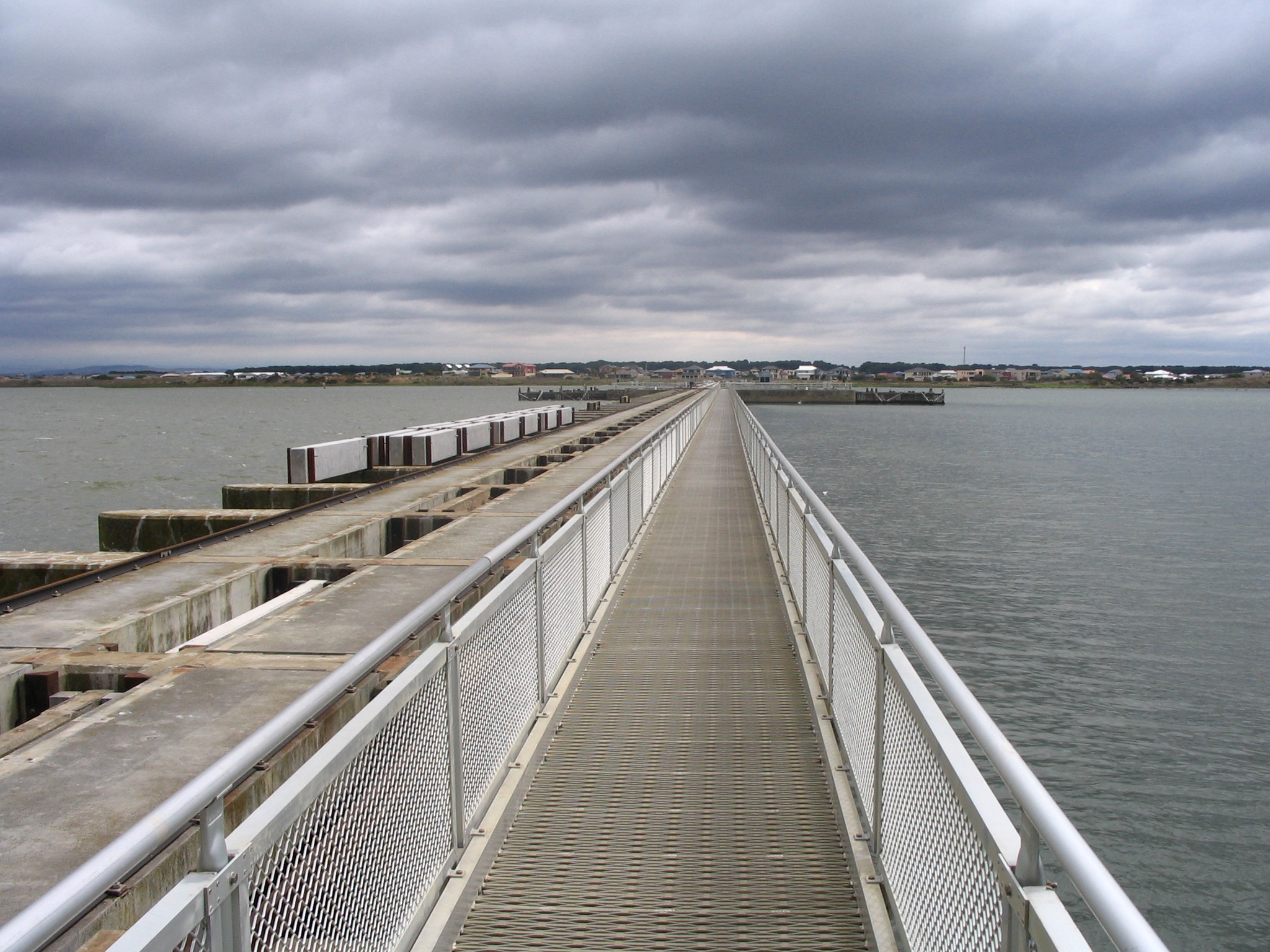
Drove to the Goolwa Barrage, then on to the boat launch. Walked from there to the Murray Mouth on the Sir Richard Peninsula. As the guy in the info centre said, yes, you can do that, but it's a long (three hour return) hard slog through some uninspiring scrub on an evasive track. It's the sort of thing only someone who'd never think of doing it could assent to.
This is the Murray Mouth from side on (Southern Ocean on the right, Lake Alexandrina on the left, Younghusband Peninsula straight on). The incoming waves exert more force than the freshwater from the river, and given the four-States-and-the-Feds politics involved, South Australia has decided to use Federal money to continuously dredge the Mouth so the Coorong gets the occasional flow.
I tried to cadge a lift back from the mouth from some fisherpeople but was rebuffed on the pretext of no space. They warned me off trying the ocean side, which I think was pretty self-evident given the wind, though perhaps not to me in my ennui-enervated state. A solitary brown snake was a little more friendly on the way back.
The touristic alternative to my hike is to drive through Hindmarsh Island and look at the Mouth from directly opposite. Note to self: drive first, then maybe walk. There's a new Marina Development designed to milk Adelaide's BMW / wine tour set, and some McMansioning west of that. I opportunistically and expensively grabbed some lunch at Bocca Bella's Café at the crossroads, housed in an old school building. Good food, effusive hosts.

This is the Murray Mouth from straight-on, and it's easy to imagine the Mouth when there was more water flow.
In this part of Australia all roads lead to (or equally, away from) Adelaide. I naively followed the signs that said "City" and before I knew it the Anzac Highway left me on their George Street equivalent. Perhaps Church Street is a better approximation as Adelaide seems quite like Parramatta to me. I found an internet café and quickly surmised that there was no theatre on in the near future; the town is hibernating in preparation for the all-consuming Festival. Similarly a lot of hostels appeared to be mostly full, though as usual there was a bed to be had, in this case in a ten-man dorm in the Shakespeare Hostel. Apparently they mostly cater for international uni students while they find somewhere to stay. Pretty standard as far as backpackers go.
Hit the world-famous Rundell St with An from Melbourne, a friend-for-the-night from the hostel, ending up at The Elephant (British) Bar on Fringe Alley. We reckon there's a man shortage in Adelaide, most men in town are cops, and there's a cop on every street.
I enjoyed this the most out of the books of hers I've read so far. The cataloging keywords are: anecdotes, attitudes, family relationships, women authors, political and social views; all apposite, and here there is no claim to anything beyond indulging the need to write.
I particularly enjoyed:
- Writing Home.
- Regions of Thick-Ribbed Ice, an account of her trip to Antarctica.
- Tower Diary, of post-breakup trauma in Bellevue Hill.
- Melbourne's Famous Water, of returning to Melbourne (home).
- A Spy in the House of Excrement.
... and pretty much the rest of it. She writes in an intimate style that would make for a decent blog.
Crap weather today, raining on and off with varying intensity all day. So what to do but drive around looking for things to look at?
Walked to the beach at 42 Mile crossing, running into an emu and tourists along the (approx) 3km round-trip through sand dunes and scrub. This is the Southern Ocean beach at presumably high-tide at the end of the crossing. The 4WD track is indeed four-wheel-drive only.
Drove up the Princes Highway a bit and got onto the Loop Road. Got onto some ad hoc section of the Lakes Nature Trail, trekking across the salt lake. The crystalline formations remind me of ice on the streets of Göteborg after a few days of snow and rain.
Remaining optimistic I drove around Lake Albert, down to Mark Point and as close to the barrages as one can get in a car. The rain turned me off doing any heroic walks. Returned to Meningie for some lunch via the car ferry that runs between the headlands separating the Albert and Alexandrina lakes.
After making it up to Meningie I concluded that the southern part of the Coorong is not so great without a 4WD vehicle, a boat or a fishing fetish; the scenery just isn't that inspiring.
With more reason to be optimistic I took the car ferry across the Murray to Wellington, and made my way down to Point Sturt in search of a campsite, only to find it quite exposed and ringed by private property. There are loads of vineyards down here.
Headed to Clayton, and got a campsite right on the Alexandrina at the very pleasant Clayton Bay Wetlands Caravan Park for fifteen dollars. In the night we got some heavy rain, thunder and lightning. Had some fish for dinner from Sails, the local café-restaurant, and I can't recommend the Murray Mullet. Another pretty little town.
Tried to find Picaninnie Ponds and completely failed. (There are precious few direct links between things out here.) Did find the Ewens Ponds, though. The South Australians have some strict-sounding but apparently unenforced policies, like snorkelling with a buddy and only six in the pond at once. I didn't bother getting into the water.
Drove on to Mt Gambier. For those heading east-to-west South Australia is kind enough to give one back half-an-hour of one's life, which some would say is quickly burnt by simply being in this State. This is the famous Blue Lake, which is just on the edge of town. It's the water supply so there's no swimming.
Lunch in Mt Gambier at the Jens Hotel. Wandered about trying to find the post office. Going west the roads turn into 110 km/h shoulderless wonders. Made a beeline for Beachport in the hope of getting a swim in before day's end, and had a dip in the Pool of Siloam there, a small kids' pool that is purportedly seven times saltier than the sea.
The Woakwine Cutting, just north of Beachport.

The big lobster in Kingston SE.

The Granites are South Australia's answer to Victoria's 12 Apostles. New South Wales is yet to enter the competition.
The Coorong is the overshoot from the lakes at the River Murray's mouth. I'd been keen to see it since I set eyes on a massive photograph in the transit lounge at Adelaide Airport. Apart from some idealised vision of the Murray Mouth I had no idea what I was getting into.
The Old Coorong Road is not signposted, at least from the south. I found 32 Mile Crossing by accident, and the signposted campsite looked quite dire or even absent, a big fenced-off bog. My maps proved hard to use, with some showing the roads and towns and others the facilities. I found the one in The Tattler to be the best despite it leaving out lots of roads. The area around Goolwa is quite well covered by the map from the information centre although it too does not cover all the roads.
I ended up camping at 42 Mile Crossing with about 10 other people. Got in around 7pm, too late to get a decent site, and so had to settle for a sandy spot directly opposite the self-register stall. It's four bucks for the night (per car, I think motorbikes get a discount). The mild rain was a bit of a bugger while pitching the tent, making me think I would struggle in proper rain. Conversely the car is enjoying the wash. It's very humid inside the tent.
Pretty strange. It struck me as an unsuccessful precursor to Kubrick's The Shining.
As recommended by Parks Victoria, I tried booking a campsite in the Lower Glenelg National Park at the Nelson info centre but they weren't biting. Give it a shot, they say, can't imagine they're full.
Went the long way around, avoiding South Australia: to Dartmoor, along some dirt roads, through pine plantations harbouring emus and kangaroos. The town is pretty dead: I sat in the coffee lounge at the general store for quite a while and no-one tried to sell me anything. The wood sculptures on the main street are quite cute, apparently representing some war veterans. Here's some guys sculpting with chainsaws.
Continuing the loop I found the Waterfall Gardens, a beautifully presented private property on Wanwin Road, fronting the Glenelg River. It's a bit pricey at five dollars for a walk and fifteen for two-thirds of a (good) lunch.

On to the Princess Margaret Rose Cave, which is a single limestone stream cave. There's a boat ride there from Nelson. All I can say is don't go on the 2:30pm tour, as that is when the boat gets in. The guide pointed out some tree roots going down twenty five metres and more in search of the water table. (The one with the green ribbon around it.) The area has subsided due to the overuse of the aquifer, manifesting as broken columns in the caves and a lowering of the Blue Lake at Mount Gambier by two metres in twenty five years. Ironically the whole Cave area uses (undrinkable) bore water.
Once again the Smage has been there before me and has all the vital statistics.
Swam in the Glenelg near the jetty there. Almost no current, few boats, quite peaceful. Jetties are not as useful as boat launches for getting into and out of the water. The idea is to avoid a scramble up a muddy river bank, which is where a concrete boat launch is most helpful.
The campsites at the Cave are fairly pleasant, though the choices seemed to be between ones they were watering and ones with loads of ant nests. There's a single hot shower for each sex, and no potable water. The damage is fourteen bucks a night, which (I now realise) is cheap for several people. A little blue wren joined me for dinner, the bulk of which was Heinz's Butter Chicken soup, not bad keep-alive food.
Slow start. Wow, free wireless on the main drag of Port Fairy (just out the front of The Juice Port). Had a decent coffee at Ramella's. Walked around Griffith Island (lighthouse on the far corner, otherwise a nondescript scrubby sand-dune and bluestone bird sanctuary) and had a quick swim at the Eastern Beach, which was packed. The Victorians put the flags right next to each other and only have one set per beach, not so effective when there is four kilometres of not-so-large surf.
Drove on to Portland, another big city on the Great Ocean Road. Got sidetracked into looking at a fishing spot on the Fitzroy River, but didn't stay long as the stomach was rumbling. I'm really spoilt for choice now with several beautiful spots coming up — the Glenelg River and the Discovery Bay, and all that stuff beyond Mount Gambier.
There's a big windfarm between Port Fairy and Portland, most of which seemed idle. If the little coupling to the grid near the road is for the whole lot of them then it seems to be a lot of engineering for little energy.
Grabbed some lunch at a little café near the bay in Portland, and then had a snorkel off the breakwater on the advice of the very helpful young lady in the info centre there. It's a popular spot for fishing and is quite calm, and indeed there were some fish to be seen. Drove over to the picturesque microtown of Bridgewater for a swim ("One of the (few?) best beaches in Victoria" according to the aforementioned young lady), and hence up to the peninsula to see the seal colony, which turned out to be a two hour hike too far. This is the Petrified Forest ("it's like the surface of the Moon" said the lady in the Port Fairy info centre) and I didn't really see the promised blowhole. This is all part of the Discovery Bay Coastal Park.
After that I made a beeline to Nelson, which is the end of the Great Ocean Road according to the official touring map. I had hoped to spend the night in the Lower Glenelg National Park but had left it a bit late to acquire the requisite permit. Luckily I got a pseudo-site in the picturesque, tiny, secluded and convenient River Vu caravan park, right on the river. (While it was nominally full the French-Canadian hostess allowed me to pitch my small tent on a cheap non-site in the picnic-table area.) Went for a lazy freshwater paddle at the estuary beach on the Oxbow, which is really a kid's beach and suffering somewhat from the drought. Had a few beers and a snapper for dinner at the Nelson Hotel. Talked a bit with some older Melbournians out on a tour, was a banquet to many mosquitoes. A really beautiful little town. (The Smage review is a bit out-of-date. There is an info centre there.)
Sifting through the dregs of the blog from my time in Sweden I came across these classics from Cathy Wilcox. Enjoy.


Despite what the map claims or a Victorian might tell you, the Great Ocean Road really only goes from Torquay to Apollo Bay. After that it goes inland behind Cape Otway and mostly stays there, apart from the satellite stretch around Port Campbell, home to the many Sydney Unis worth of formations that are some of the major attractions along the road. (This is all that's left of London Bridge since its collapse in 1990.) By the time one gets to Princetown it's just another name for the big fat Princes Highway (A1) running between Mount Gambier and Geelong.
Walked a bit around the Cape. Drove up to the Otway Fly Tree Top Walk, but at twenty dollars for an hour-and-a-half, signposted at the absolute last minute, I gave it a miss. Drove further down the dirt road into the National Park for a free walk to the Triplet Falls through some quite beautiful rainforest. It pays to study the guide a bit more — if I'd gone to Lake Elizabeth there's a chance I might have seen a platypus on this trip.
Lunch in Port Campbell, where one can park right on the beach. Tried snorkelling there but failed to sight any fish. For the first time this year I donned my spring suit, though it turned out to be superfluous.
Stopped off at a random subset of the limestone formations. Supposedly there's a penguin colony at London Bridge (now Arch) but I wasn't there at the right time to see them.
Took the back road to Warrnambool, ended up at the mouth of the Hopkins River at Logan's Beach. It's a big town and lacks the holiday / country feel of the others on the Great Ocean Road. Tried swimming at the main beach but didn't last long due to the seaweed and ennui.
Drove on to Port Fairy, took the cheapest caravan park in the book from the info centre, the Catalina Park. It said fifteen bucks but they wanted twenty-two (the discrepancy due to it being the high season), we settled on twenty. For me it's just paying to take a shower and perhaps use the cooking facilities. Cheap means its right on the highway, so I've gone from the sublime surf-crashing-into-the-cliff to the truckers grinding their gears into town.
Am incubating Peodair and Rachel's flu quite successfully. Spoke with Mum and Dad briefly on the phone; Dad had had an adventure getting back from Inverell to Orange on public transport.
Bernie drove us back to Anglesea for breakfast at a decent café in the middle of town. I had some lunch in the holiday park, not much more than a snack. Decided to push on to the Otway National Park today in spite of (compulsorily) having paid for the campsite for this evening too. Had a dip at the beach at Lorne on the way, not much more than a kiddie's pool, and at Apollo Bay, which is quite a picturesque town. Had dinner at the Great Ocean Hotel at the western end of it.
It seems the hitherto fine weather might be coming to a close; similarly to last time I was here (with Lev in Easter 2000), there's a fat band of high cloud taking up most of the sky. We got some light rain but nothing too inconvenient.
Following the map I tried to camp at Cape Otway itself, but the joint was closed. (The campsite was marked "Cape Otway GOW Campsite" and I now realise "GOW" stands for Great Ocean Walk — so it's probably only accessible by hard slog.) Backtracking I made my way towards the Parker Hill and Blanket Bay campsites and took a fortuitous turn down to Point Franklin, a beautiful little campsite with a great view of the Lighthouse. It's not on the Parks Victoria map and not signposted for camping until one arrives. (Camping in Australia (Cathy Savage, Craig Lewis) does mention it, however.) Supposedly there's a charge for driving in and also for camping, but no ranger tried collecting money from me. Perhaps if one turns up after 7pm or so...
I got bogged taking the high road over a little hillock into this perfect little hollow, landing the Lancer's low underbelly on the peak; I didn't remember what low wheel clearance she's got. With the help of some swearing and my fellow campers Mark, Timmy (his wife, from Hungary) and her mother, we managed to get the Lancer back onto the flat. Lesson learnt: use sticks rather than rocks, as they don't tend to slide out so readily, and that the low road is there for a reason.
When I was here with Lev we managed to flatten the hire car's battery, so I reckon this place is cursed despite (or because of) its incredible beauty. The Cape marks the end of the Surf Coast and the beginning of the Shipwreck Coast, where I hope there's some snorkelling to be had.
Breakfast at a pretty crap café roughly opposite the holiday park; expensive and the food wasn't so great. This trip is going to bankrupt me. Bernie, Hui Nee, Peodair and I headed down to the beach just east of the Split Rock Lighthouse for a paddle. After some flaffing about we had some lunch with Rachel, apparently mostly recovered from her malady, at a fish and/or chip shop in the heart of Aireys. I went for a walk around the Lighthouse.
Headed over to Fairhaven beach for a mid-afternoon swim; Bernie was enjoying himself immensely, while Peodair managed to turn himself into a poor facsimile of the English flag. Went to the Lorne Hotel, about 20kms east, for dinner. Lorne is roughly at the limit of what people from Melbourne are prepared to drive for a weekend away, so there are plenty of expensive cafés, restaurants, bed-and-breakasts, etc. there.
Back to Aireys Inlet Holiday Park for a sleep.
Had a late breakfast with Bernie at the Groove Train on Bridge Road. Went back to the mechanic as the wheel alignment on his car isn't right (and still isn't). Bernie attempted to rotate the tyres with mixed success.
Headed off to Aireys Inlet in the mid-afternoon. It's a little holiday town near the start of the Great Ocean Road. Took ages to get through Geelong due to a crash, apparently some rear-ending. Aireys Inlet Holiday Park is schmick enough, though they charge for everything; we're paying for five people for three nights even though Rachel didn't make it down today and we're only staying for two.
Late-afternoon swim at Fairhaven, out the front of the surf life saving club. Decent surf and the water is not that much colder than Coogee in early spring. Most people wear wetsuits of some form or other. Some surfers had some success.
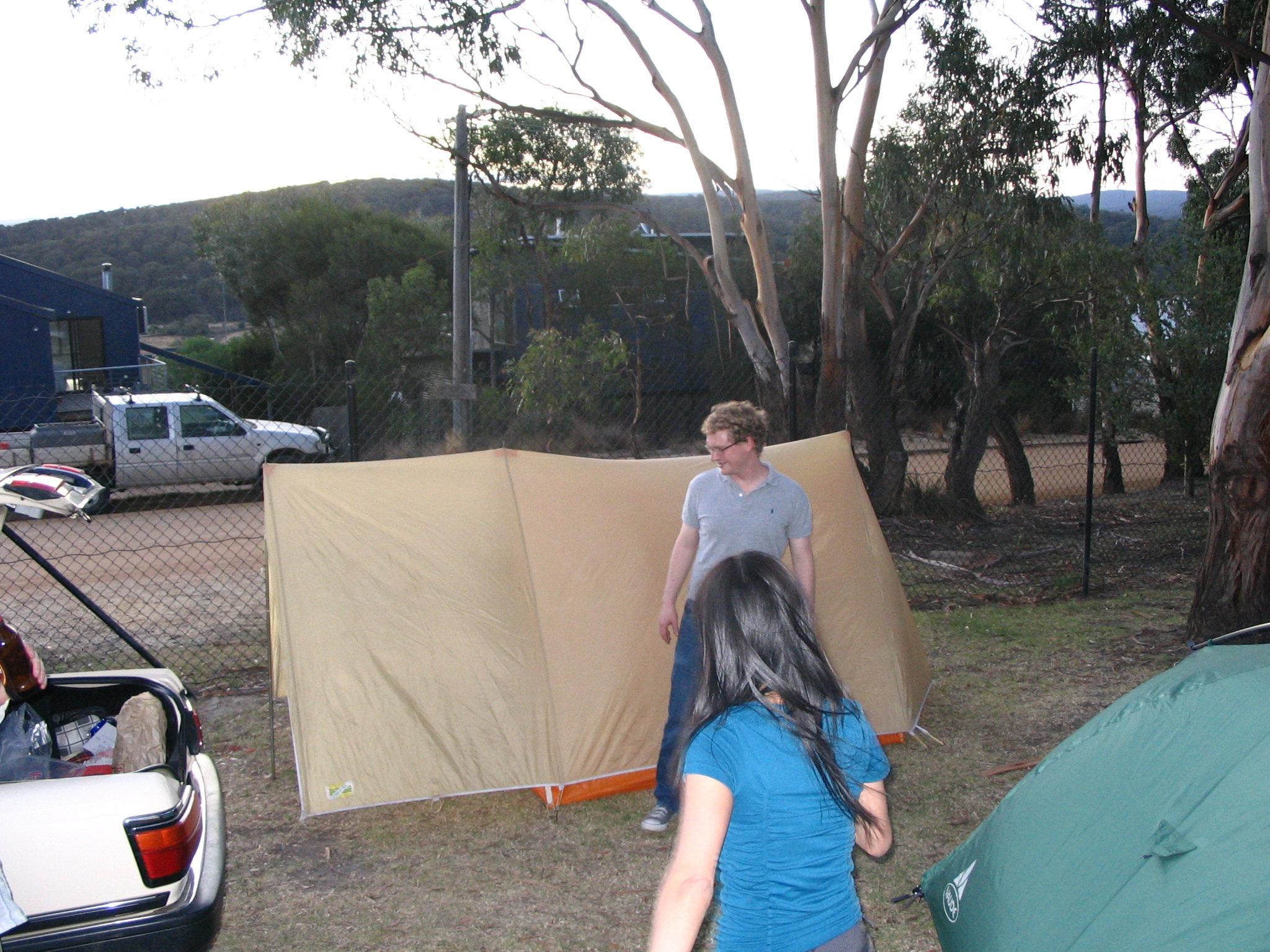
Bernie, Hui Nee and Peodair came down around 8pm and loads of fun ensued trying to erect the tents. Pitching Peodair's TrendSetter love shack required careful attention be paid to the oral traditions of the Leihy tribe. We spent the night in the local pub, The Inlet.
Got up around 8:30am and took about an hour and a half to slowly get my stuff together. Drove in search of Lake Mokoan with little success, and bypassed Glenrowan by accident. Ended up in Benalla (an almost-perfect sounding town for me) where the kind lady in the info centre directed me to a nice spot for a dip in Lake Benalla. No current, quite warm (at the surface at least). (Contrast to Gandagai, where the lady was worried I'd sue her if she gave me the same sort of advice!)
Someone (Bracks? Kennett?) has gone through these northern-Victorian towns and beautified their main streets according to a banalification masterplan. The road is two lanes wide, with a dedicated right-turn lane. Careful pedestrians can block the intersection by crossing in front of a left-turning car, perhaps provoking road rage some imagine foreign to the country.
Stopped at Seymour for lunch, the town nearest to Puckapunyal. Drove the last hundred-odd k's to Melbourne and got stuck on Sydney Road. There's got to be a better way to get to Richmond. Met up with Bernie, picked up his car from the mechanics, did dinner with him, Hui Nie, Peodair and Rachel at a Vietnamese soup restuarant on Victoria Road. Started organising for the weekend; fortunately for me Bernie's car is big enough for everyone's stuff.
Early start: got Dave to work at 9am. Bought some more gas at Paddy Pallin; it was cheap in the first place (ten bucks for 460g) and more so with a ten-percent discount, but I blew fifty cents on parking in Lonsdale St. Had a coffee at The Front Gallery & Café in Lyneham, surprisingly open and busy at 10am. They're so considerate they even have free wireless.
Drove down to Gundagai in some brain-boiling heat. The Hume is much unloved around that town, oscillating between (crappy) single and (reasonable) dual carriageway all the way to Albury. Had lunch in Gundagai and also tried swimming in the Murrumbidgee near the old bridges. The current was a bit too strong for me. Pushed on to Albury and more successfully swam in the much more popular Murray at the Australia Park, quite near the State border. Beautiful, and I wish I'd known about it before.
After consulting Camping in Australia (Cathy Savage, Craig Lewis), I prevaricated about camping near Wangaratta at the Wenham campsite in the Warby State Forest or opposite the iconic Puckapunyal army training site (about 80km from Melbourne). Wangaratta won as it leaves me with a decent (230km) drive for tomorrow. Got into town too late to find out anything from the info service, and my invitation to crucifixion (an old Nick Cave The Lyre of Orpheus tour t-shirt) was roundly ignored.
The book lead me up the garden path. The camp ground is about 20km from Wangaratta in the middle of the state forest, with the last 5km or so along some dirt tracks. There are no views (though none were promised) and the purported camp-ground is covered in sheep crap. Yep, it's secluded, free and tonight there's no-one else about, but where's the fun in that? The Ovens River probably has some nice sites.
Thoughts for the day:
-
The material and labour market economies put Pareto optimality at the forefront of everyone's mind. (Roughly, some magical process (the market) arranges things so no-one can be made better off without making someone else worse off.)
The currently celebrated scenario where this doesn't matter is of course peer-to-peer networking, for things that are cheap to duplicate and distribute. This also gives some insight as to why leaching in these domains is more about morality than anything rational — see Shirky for more (Ratios don't make much sense as the whole game is zero-sum anyway, and also very dependent on demand.)
Another that struck me is driving: a lot of people tail-gate, giving the impression of wanting to overtake. I'm more than happy for them to do so; I just wish they'd realise they could make me a lot happier by backing off until they're in a situation to pass me.
- HTML still sucks.
- There was a story on Confucianism on Radio National; a lot of it sounded like conservative claptrap of the form "respect and obey your betters". Perhaps the philosophy distinguishes comprehension of social mores and acceptance of them, but that didn't come through in the program. (Raymond Smullyan's portrayal of taoism is conversely quite irreverent.)
- I need to put a new notch in my belt. The magical mystical disappearing waistline.
Remembered just about everything except some batteries, charger and soap. Standard boring-as-hell drive to Canberra. Bought a new pair of Docs at Redpath Shoes (URL on bag is defunct), seemingly the last purveyor of Docs in south-eastern Australia. Dinner from Sammy's, ate it on the lake near the National Museum. Lots of little wrens enjoying themselves, including a beautiful blue fairy wren that skillfully avoided my camera. Met up with Dave after work at 10:30pm, talked with him and Luke until 3am.
This is much like his autobiography, quite indulgent and rambly. I think he summarises the text quite well in Chapter 43, Mondo on Immortality:
Zen Student: So Master, is the soul immortal or not? Do we survive our bodily death or do we get annihilated? Do we really reincarnate? Does our soul split up into component parts that get recycled, or do we as a single unit enter the body of a biological organism? And do we retain our memories or not? Or is the doctrine of reincarnation false? Is perhaps the Christian notion of survival more correct? And if so, do we get bodily resurrected, or does our soul enter a purely Platonic spiritual realm?
Master: Your breakfast is getting cold.
There are lots of things about this book which feel tenuous and loose, so much unlike the logic he did up to that time and the puzzles soon after. It'll take me a while to do it justice.
At the Verona with Jen. An American movie made for American audiences; most players act irrationally and moreover little justification or explanation is provided. The insensitivity and self-centredness of the American couple hits us over the head time and again, like politicians' cliches (rapidly converging with management sprok). Way overlong and overblown.
Blosxom's stitch-the-template-and-content-together code is pretty
nasty. Well, it's simple up to the point when one tries to use a fancy
interpolation (substitution) engine to, say, implement a schmick
img tag. RSS's not-invented-here-edness purportedly
disallows HTML in the feed, but in practice it appears that's fine
provided all the tags are suitably HTML armoured, which was the hoop
that Blosxom was dutifully leaping through. I just tweaked the main
script so that some interpolation occurs before the escaping, and the same
again and some more after. Voila, with ugliness comes images. Yes, this sort
of thing makes one yearn for a mainstream blogging engine.
While I'm ranting I've gotta say perl's approach of making everything
magical wears thin fast. I want predictability, and while I accept that API
docs are written to be read I don't appreciate having to read
perlsyn and perlop (and perlre)
manpages while doing simple imperative programming. How about: small
language, verdant libraries instead of here's fifteen ways to write
an enumerator? The great ideas in the language and fantastic libraries
are heavily obfuscated by noise, and I don't believe it's possible to write
robust perl applications — aspect-oriented programming has nothing
on this for spaghetti. Any sane person looking at the perlsec
manpage must surely agree with me — tainting supposedly
works provided one doesn't defeat it, by omission or commission. Mutter,
mutter.
Is it just my Safari that struggles with RSS feeds? Those bugs have been there for years now.
When the problem gets hard it pays to see what nature does; this, I guess, is a slightly more abstract reformulation of the human-based computation gambit.
So, when faced with the apparently impossible task of cooking up decent voting procedures, what did evolution do? Apparently honeybees engage in a kind of range voting.
The best by Altman I've yet seen. It's "based on the writings of Raymond Carver" and one of the subplots here was also strung out into Jindabyne.
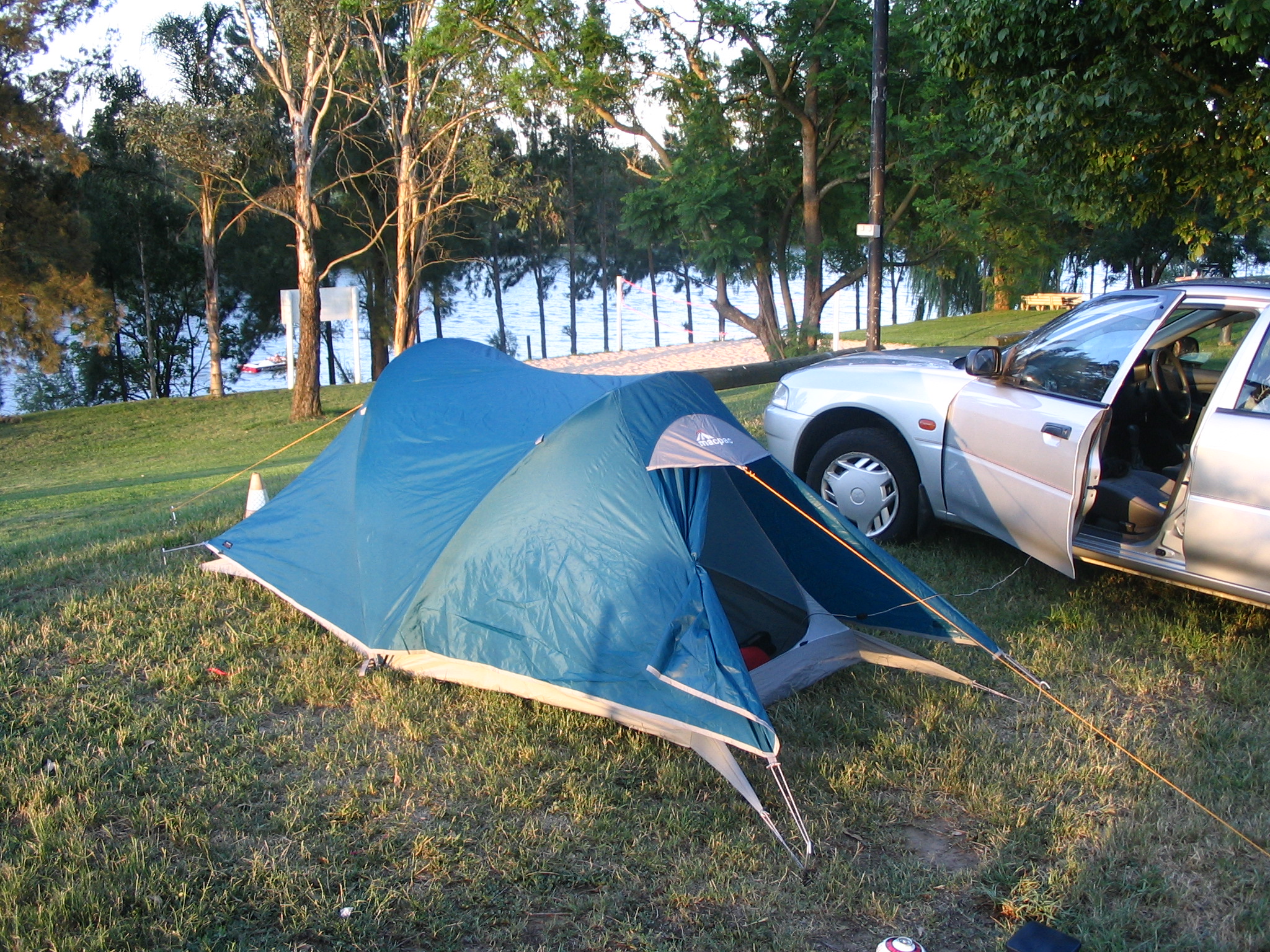
Decided to try out my tent by spending a night out at the Hawkesbury Riverside Tourist Park with the idea that if things got unbearable then it was only a 50km drive back to civilisation.
The park is on the outskirts of tiny Pitt Town, near Windsor. I got there around 5pm, early enough to attempt to swim across the river. My feeble modified-dog-paddle attracted the attention of one of the local motorboat drivers who kindly came over to make sure I was OK. There are loads of motorboats on the Hawkesbury, most with water skiers hanging off the back. It's a bit harder to float without salt in the water.
The lady very kindly let me pitch my tent overlooking the water, which is why there is such a similarity between my photo and their promo. The tent went up easily enough and the cooking gear went well too. All very low key and unexpectedly easy, if somewhat time-consuming. I was a bit surprised to get up the next morning and find the fly dripping wet, inside and out, while the inner tent was perfectly dry. It hadn't rained, but the dew was much heavier than I imagined. I wonder what one does with a wet tent on a several-day hike.
(or: reinventing PLog, one piece at a time.)
I wanted to add images to the blog, and as I'm fed up with ImageMagick I
was relieved to find that someone has written a more usable replacement for
perl called Imager. You'll need to
install that first, and it should be as easy as politely asking CPAN to
do it for you. Also you'll need interpolate_fancy
so you can invoke the method in your stories. Here's the code:
The instructions are in the script. It's still quite rough, and I'll be updating it as I go along. Take a good look at your error logs if things don't work.

The existing Blosxom image plugins are a lot fancier than this; I just
wanted something that generates thumbnails and automatically adds the
requisite attributes to the img tag. This photo is from my trip
up to Berilee last month — if you squint you can see the car ferry at
Berowra Waters. The markup is:
<@img.img src="IMG_1667.JPG"
 style="border-style: none; margin: 0 0 10px 10px; float: right; clear: right;" />
which, when run on my iBook, results in the XHTML:
<a href="http://localhost/~peteg/images/IMG_1667.JPG"><
 img src="http://localhost/~peteg/images/cache/tn_IMG_1667.JPG"
 width="93"
 height="70"
 style="border-style: none; margin: 0 0 10px 10px; float: right; clear: right;"
 alt="" /><
/a>
I get the impression that the interpolate_fancy plugin doesn't
like having newlines in the arguments.
...and yes, I am vaguely aware that those suckling on the RSS nipple are not getting the full technicolour experience. Bear with me.
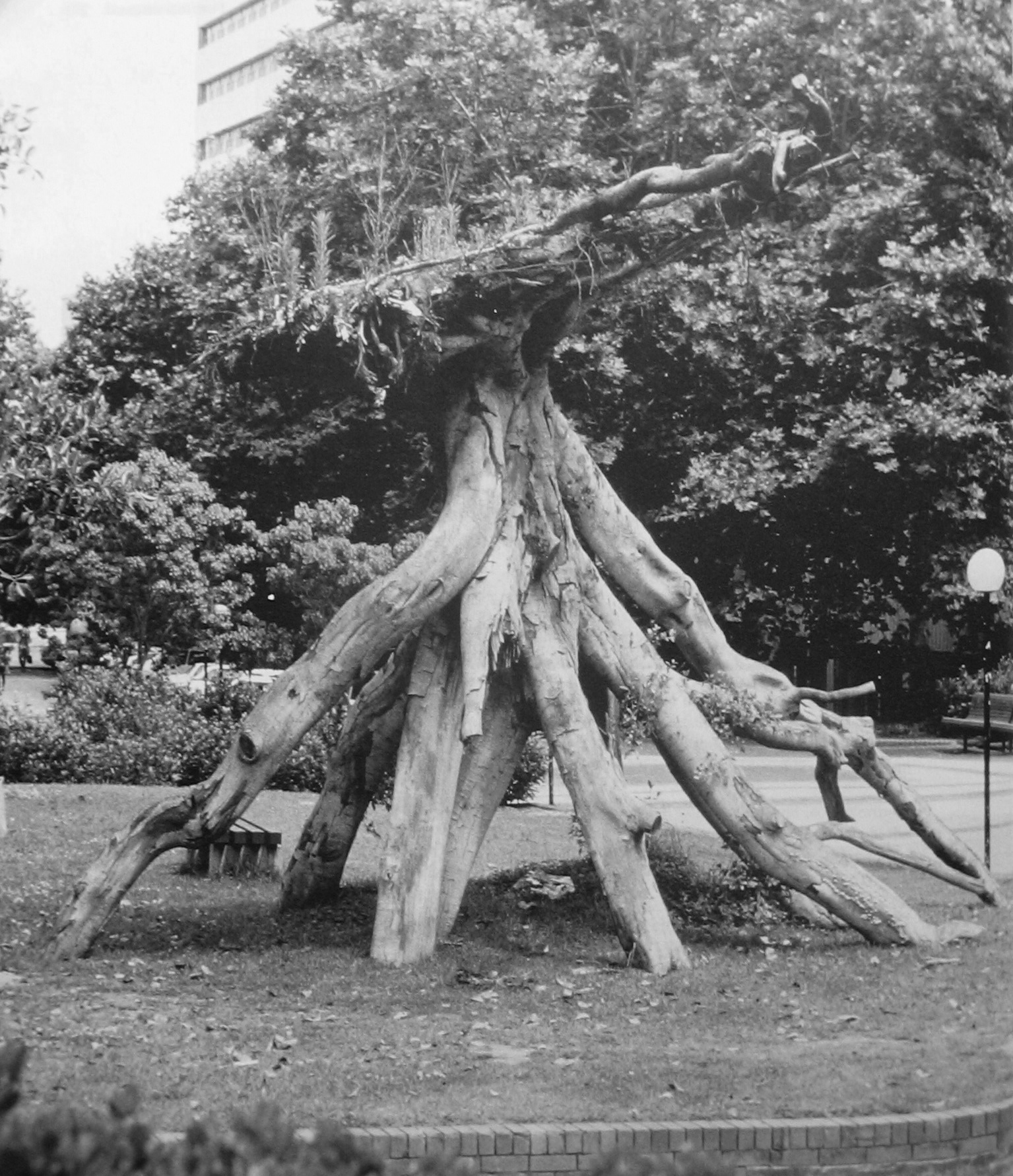
Any idiot knows a tree has a branching structure, or at least that's what we've been telling the first years since time immemorial. There was a proper CS tree at UNSW back before I got there that the internet doesn't appear to remember so well. This photo of the "right way up" fig is from Geoff Whale's data structures textbook, and carries the following attribution:
Evidence that trees sometimes really are as shown in data structure textbooks. Sculpture using the medium of a dead fig tree at UNSW. Photo by Russell Bastock.
I reproduce it here without permission. That must be the Applied Science building in the background and my guess is that it sat at the eastern end of where the Red Centre is now.
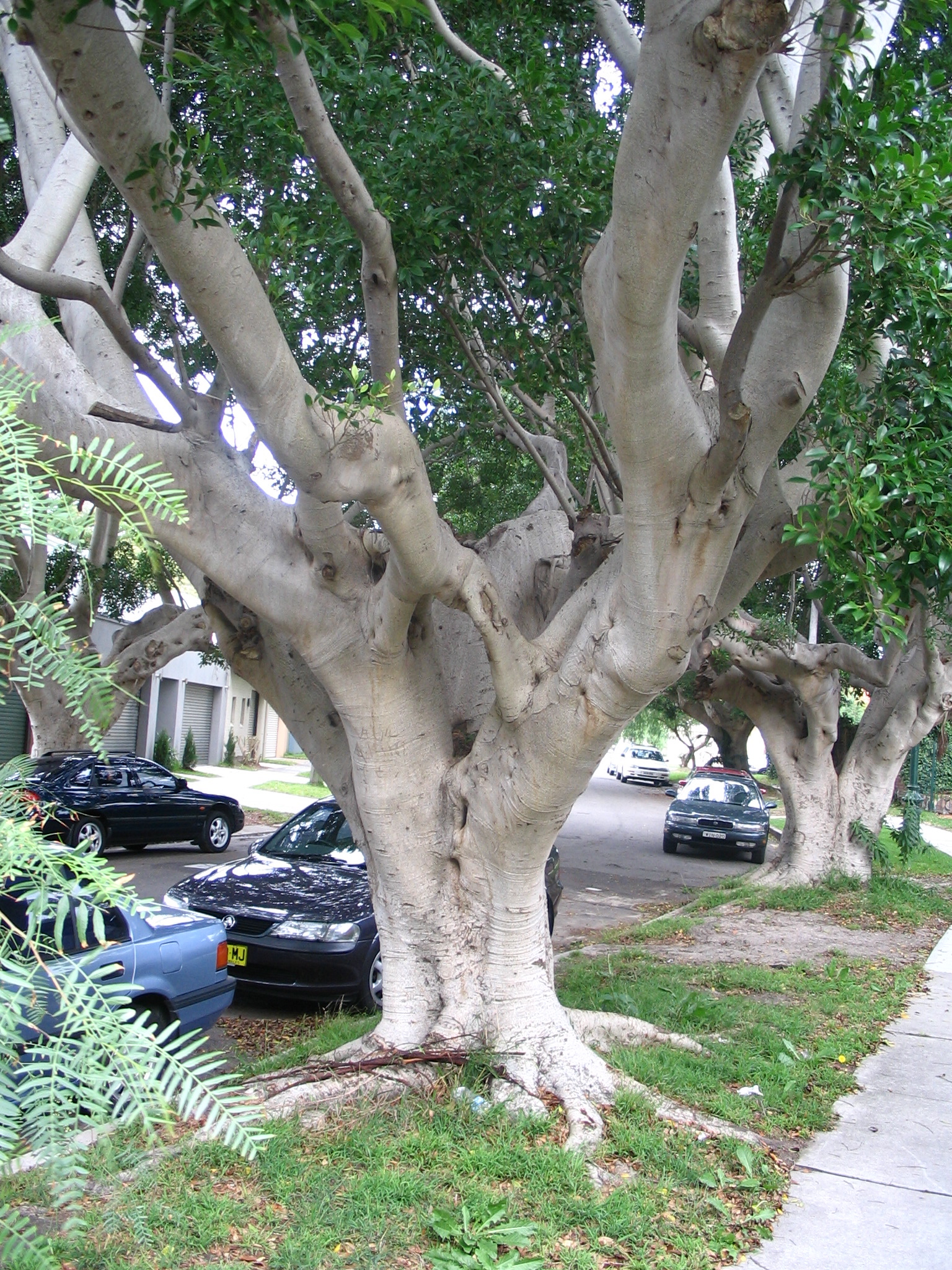
I spotted this purported "tree" on Centennial Avenue, near Avoca St (which runs between Queen and Centennial parks) several months ago but have only now got around to photographing it. I grant that it appears to be a DAG, and is therefore for most purposes a tree.
I'm not altogether sure Aardman's claymation charm survives in this movie, though lovers of (the first) Shrek will probably be satisfied. The French get an incredibly raw deal here, with the exception of an unbelievably hilarious homage to Marcel Marceau. That was worth the six bucks cheapo-Tuesday admission price at The Ritz by itself.
The formula of jokes-for-the-adults / jokes-for-the-kids is slavishly followed, and given the sewer theme it leads to some pretty off-colour humour from the po-faced albino ex-lab rat muscle; apropos last night's curry he ruminates "My bum looks like the flag of Japan". Unlike Wallace and Gromit the invention count is rather low, and the characters feel more American than English. I almost wished the Gromit toy in the opening scene had got up and done something incredibly clever and disrespectful to the self-proclaimed playrat. I think Jen was less impressed overall with this piece of "family" holiday fluff.
